Monday, 25 February 2019

EL and CCL shall be taken into account for computing Minimum Residency Period

EL and CCL shall be taken into account for computing Minimum Residency Period

AB-14017/32/2013-Estt.(RR)
Government of India
Department of Personnel and Training
New Delhi, the 25th February, 2019
OFFICE MEMORANDUM
Sub: Treatment of period of Leave towards minimum residency period for in-situ promotion under Modified Flexible Complimenting Scheme (MFCS)
The undersigned is directed to refer to DoPT OM of even number dated 30.07.2014 regarding the subject mentioned above. Representations have been received seeking clarifications regarding treatment of Child Care Leave as per extant instructions towards minimum residency period.
The matter has been examined in consultation with Department of Science and Technology and the following clarification is issued:
Clause (v) of Para 4 of OM AB 14017/32/2013-Estt.(RR) dated 30.07.2014 may be replaced with the following clauses:
EL and CCL shall be taken into account for computing Minimum Residency Period
“(v) Earned Leave for a total period of not exceeding 180 days (for 3 year residency period), 210 days (for 4 year residency period) and 240 days (for 5 year residency period) sanctioned as per Leave Rules shall also be taken into account while computing minimum residency period.
(va) Child Care Leave sanctioned as per Rules shall also be taken into account while computing minimum residency period”.
For removal of doubts, it is clarified that the above said modifications will be effective from 30.07.20 14, i.e. from the date of issue of the said OM.
sd/
(G. Jayaithi)
Joint Secretary to the Government of India

Read More ->>

PIB: Awareness workshop for Central Government Pensioners

PIB: Awareness workshop for Central Government Pensioners

Awareness workshop for Central Government Pensioners held in Chennai
An awareness workshop for Central Government pensioners was held in Chennai today. It was organized by the Department of Pension and Pensioners’ Welfare. Around 150 pensioners participated in the workshop. Shri. Sanjiv Narain Mathur, Joint Secretary, Department of Pension and Pensioners Welfare, Government of India, inaugurated the workshop.
In his inaugural address, Shri Sanjeev said that the department is conducting a series of awareness workshops all over the country, for the welfare of pensioners and IVRS facility will be launched soon for grievance redressal for pensioners. He also said that in the pension adhalat conducted last September, over 9300 grievances was sorted out on the spot. He mentioned about the documentary film on digital life certificate and requested the pensioners to watch for clarification.
The sessions in the workshop covered post-retirement benefits, CGHS facilities, investment option and Income Tax benefit available to the senior citizens. The sessions provided a detailed over-view of entitlements of the pensioner & other benefits. They also got to know about Bhavishya Software which is a common online platform for processing of pension cases by all civil Ministries/ Departments of Government of India. This system is now integrated with PAO and CPAO through their online module, PFMS and PARAS respectively.
PIB
Read More ->>

What food should you have on what day

What food should you have on what day


Sunday : Apart from it being a weekly off for most people, this is also the best day to tuck into different kinds of foods including plants, meat and fruits as all of it radiate the Sun's vibrance.

Monday : Since it's the day of the Moon, which signifies the element of water, it makes sense to consume things that have a high water content like watermelon, cucumbers and pumpkins.

Tuesday : Mars is the planet that rules this day and it radiates heat. Try mangoes, dates and pineapples on Tuesday.

Wednesday : This day belongs to Mercury, which is a dual planet. Hence you can consume all kinds of food on this day.

Thursday : The day belongs to Jupiter. Consume food that are orange or yellow in colour like oranges, lemons and bananas.

Friday : This day belongs to Mercury, which is a dual planet. Hence you can consume all kinds of food on this day.

Saturday : On the day of Saturn you can gorge on junk and oily food as the planet rules oil.
Read More ->>

BSNLEU strongly opposes implementation of VRS in BSNL

BSNL EU strongly opposes implementation of VRS in BSNL

BSNL EMPLOYEES UNION
Recognised Union in BSNL
(Registered Under Indian Trade Union Act 1926. Regn.No.4896)
CHQ:Dada Ghosh Bhawan, Opp. Shadipur Bus Depot., New Delhi – 110008
Email: bsnleuchq@gmail.com, website: bsnleu.in

P. Abhimanyu
General Secretary

BSNLEU/604 (DEV)
25.02.2019

To,

Shri Anupam Shrivastava,
CMD BSNL,
Bharat Sanchar Bhawan,
Janpath, New Delhi – 110 001

Sub : – Implementation of VRS in BSNL – reg.

Sir, We learn that, both the BSNL Management, as well as the DoT, are actively considering the implementation of VRS in BSNL, as a measure of reviving the Company. In this connection, we also wish to draw your kind attention to an article carried by the DNA newspaper on the subject on 11-02-2019, based on an interview given by the CMD BSNL. He had reportedly told the newspaper that, BSNL’s large work force was one of the biggest challenges for the Company. Further, the CMD BSNL had also reportedly told the Newspaper that, the other telecom players are having only around 25,000 – 30,000 employees, while BSNL is having 1.8 lakh employees, which is five times bigger than the workforce of the private telecom companies, and that the annual wage bill of the employees comes to Rs.15,000 crore.

When the entire employees of BSNL have contributed in a big way for the financial improvement of the Company, by launching many movements like Customer Delight Year, Service With A Smile, BSNL At Your Door Steps, etc., it is highly unfortunate that the employees are being made scapegoats for the financial crisis of the Company.

It is pertinent to state that, it is the same BSNL, which earned Rs.10,000 crore net profit in the financial year 2004-05. At that time, at least one lakh more employees were working in the Company. When the BSNL earned Rs.10,000 core net profit in 2004-05, definitely the Company has no reason to go into loss, after the employees strength has shrunk by more than one lakh. So, the reason for BSNL’s financial woes lie some where else. Everyone will agree that the revenue earnings of BSNL have gone down drastically during the past couple of years. The brutal tariff war initiated by Reliance Jio is certainly the main reason.

The other reason is the failure of the BSNL Management to launch it’s 4G service on time. It is also a fact that valid suggestions given by the unions and associations to increase the revenue earnings of the Company, were ignored by the Management. For example, time and again the unions and associations had been telling that FTTH is one area, having the potential to enhance BSNL’s revenue sizeably. However, it was ignored by the Management. Short supply of stores and materials had always been a problem. Today, Reliance Jio is entering in a big way in this area.

At present, BSNL’s mobile towers are being maintained by our own employees. In most of the places, the uptime of our mobile towers is very good. However, the Management has decided to outsource the maintenance of these mobile towers, paving way for the wastage of funds in a big way. The AUAB has opposed this outsourcing and has demanded it’s cancellation. However, so far, the Management has not even bothered to discuss this issue with the AUAB.

The employees have sacrificed their PLI, LTC, medical allowance, etc., from 2010 onwards. At the same time, the top officers of the Company continue to enjoy all the luxuries. They splurge huge amounts on account of frequent and unproductive foreign tours. Executive f business class travels by air, staying in 5 star hotels, elite club membership, etc.., are the luxuries being availed by the top officers. Even some inconsequential officers, who are close to the top Management, enjoy foreign travels in the interest of the Company.(?) The officers who are in the good books of the top Management are being generously appointed as consultants, after their retirement. The ARAB has already written to the Management, demanding implementation of austerity measures for the top officers. However, the demand has fallen on deaf ears.

The CMD BSNL has told the DNA that, the BSNL is working on various models to implement VRS, based on the report of the IIM-Ahmedabad, which had recommended implementation of VRS to 35,000 employees. We wish to ask, what is the necessity to implement VRS, when massive retirements are taking place and the strength of the employees is depleting fast? Further, the VHS is already implemented thrice in MTNL. It has not helped MTNL to come out of the crisis. In fact MTNL’s crisis has deepened now. The government and Management may say that VHS is voluntary. But, It Is true that the government has already started taking various measures for making the employees to become panicky, with the view to force them to go on VRS. So, in effect, the proposed VRS will only be a CRS.

In view of the foregoing, BSNLEU strongly opposes the proposal of implementing VRS in BSNL. We request that the proposal may kindly be dropped.

Thanking you,

[P.Abhimanyu]
General Secretary

Source : http://www.bsnleu.in
Read More ->>

How Digital Technology is Powering Doorstep Banking in India?

How Digital Technology is Powering Doorstep Banking in India?

As part of the government of India’s push to broaden financial inclusion across the country, the Reserve Bank of India, India’s central bank, has licensed a unique form of banking which has not been used elsewhere in the world.

The new model, called payments banks, operate like any other bank except with limited offerings. Their key remit is to widen the spread of payment and financial services to small businesses, low-income households and a migrant labor workforce in a secured, technology-driven environment. India Post Payments Bank (IPPB), hosted under the Department of Posts, is the only public sector entity to have been issued a licence to operate a payments bank.

Thinking long term

Setting up a brand-new, digitally-focused bank is no task for the faint hearted. Right from the beginning, IPPB needed to think long term and create a banking ecosystem that was both cost effective to run and scalable over the years.

The challenge put to DXC was to design a technology solution for IPPB to serve the nation and drive development toward a truly digital India. DXC provided the digital roadmap and set up the entire IT infrastructure and business applications for this ambitious project.

“IPPB’s vision is to build the most accessible, affordable and trusted bank for the common man. Towards that, it was critical to invest in a scalable and resilient solution that leverages the existing interoperable payments infrastructure to achieve affordability, while ensuring simple and intuitive interfaces for easier adoption by the customers and the service providers,” says Suresh Sethi, CEO of IPPB.

“The solution we developed for IPPB was designed with the constant need to keep operational costs low,” says Bhushan Sharma, Managing Director of DXC Technology in India. “We used a light operating model with minimal data entry, straight through processing and digitization. We also used a mix of reliable open-source solutions to keep the cost of IT low.

“In order to meet the changing industry demands and stay relevant, we implemented a future-proof platform and solution with more than fifty business applications aligned to a robust product roadmap.”

Serving the people

IPPB now offers customers an integrated suite of core banking services to support savings and current accounts, payments, money transfer, direct benefit transfers, bill and utility payments, and enterprise and merchant payments. One of the most important functions of IPPB is its ability to deliver government subsidies to people. These products and related services are being offered through counter services and via smartphone-based, hand-held devices carried by postal staff.

IPPB is also looking at the unorganized retail segment, where payments today are largely dominated in cash. It wants to create a ‘less cash’ system that allows these kirana stores and merchants to use IPPB accounts and interact digitally.

Taking it one step at a time

Following successful pilots in 2017, IPPB expanded country-wide in September 2018, opening 650 branch offices, setting up 3,250 post offices across urban and rural India to operate as banking access points, and, most importantly, offering counter and doorstep service through around 10,000 postal staff and gramin dak sewaks. For the launch, IPPB invested more than 800,000 hours into training 15,000 postal staff and since has achieved one of the fastest expansions of over 100,000 banking access points while also training and certifying over 250,000 service providers throughout the country.

“We are taking a step-by-step approach to rolling out our services,” says Sethi. “Although many of our customers will be familiar with banking, we’re largely dealing with people who have never used a bank before. Therefore, IPPB is initially focusing on financial inclusion through financial literacy, educating customers on how insurance secures the unsecured, how wealth grows from wealth and how even a little saving can go a long way towards building a better future.”

“We believe that a nation can only grow when every citizen gets an opportunity to prosper. With simple, diverse and growth-oriented offerings, IPPB aims to give every Indian access to a comprehensive suite of banking services.”Suresh Sethi,
CEO of IPPB.

India’s most trusted icon

The beauty of IPPB’s model is that it is based on one of India’s most trusted public figures—that of the postman or postwoman. They are the key contacts for customers, bringing banking right to their doorsteps. And this is, in essence, the bank’s slogan Aapka Bank, Aapke Dwaar which roughly translates to ‘banking at your doorstep’.

IPPB is gearing up to lead the digital evolution of banking as one of the largest financial inclusion networks in India, covering both urban and rural areas. “As we continue to expand our services to every doorstep, our postmen and postwomen will become the trusted financial services advisors to our customers,” says Sethi. “At India Post Payments Bank, we believe that a nation can only grow when every citizen gets an opportunity to prosper. With simple, diverse and growth-oriented offerings, IPPB aims to give every Indian access to a comprehensive suite of banking services.”

Sharma recalls the opinion of a 65-year-old driver and former goat herder in rural Rajasthan, who believes that digitalization is key to economic success. “We need to get money directly to the workers and the new payment banks are the answer. Banks like IPPB will make a real difference.” What better endorsement can there be?

“This greenfield model of banking should enable individuals, small businesses and merchants to utilize full-fledged digital banking services,” continues Sharma. “It’s paving the way for India's largest banking network to reach every corner of the nation.”
Read More ->>

Sunday, 24 February 2019

Ensure CGHS Beneficiaries are provided OPD Consultation at CGHS consultation charge by empanelled under CGHS

Ensure CGHS Beneficiaries are provided OPD Consultation at CGHS consultation charge by empanelled under CGHS


OPD Consultation from Hospitals empanelled under CGH

Read More ->>

Apka Phone. Apka NPS

Apka Phone. Apka NPS


Apka Phone. Apka NPS


Read More ->>

Saturday, 23 February 2019

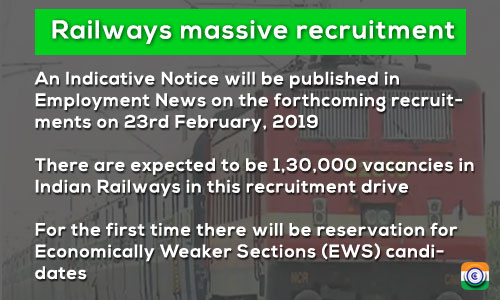
Railways massive recruitment drive to fill up its vacancies in various categories

Railways massive recruitment drive to fill up its vacancies in various categoriesRailway_jobs_2019


Ministry of Railways is going to launch a massive recruitment drive to fill up its vacancies in various categories of posts which are essential for smooth and safe running of trains.
On 23.02.2019, an Indicative Notice will be published in Employment News on the forthcoming recruitments. Indian Railways has over 1.3 lakh vacancies in different departments which needed to be filled up.
The eligible candidates for the first tranche of recruitments in Non-Technical Popular Categories can do registration of online applications from 28.02.2019. The posts included in these categories are Junior Clerk cum Typist, Accounts Clerk cum Typist, Trains Clerk, Commercial cum Ticket Clerk, Traffic Assistant, Goods Guard, Senior Commercial cum Ticket Clerk, Senior Clerk cum Typist, Junior Account Assistant cum Typist, Commercial Apprentice, Station Master etc.
The next tranche of recruitment will be available for online registration with effect from 04.03.2019, in Paramedical categories like Staff Nurse, Health & Malaria Inspector, Pharmacist, ECG Technician, Lab Assistant, Lab Superintendent, etc.
On 08.03.2019, online registration will open for candidates eligible for Ministerial and Isolated Categories like Stenographer, Chief Assistant, Junior Translator (Hindi) etc.
In all, there are expected to be 30,000 vacancies in the above three recruitments.
In addition, the Ministry of Railways will also recruit about 1 lakh staff in Level-1 (erstwhile Group-D Categories) for which online registration would open on 12.03.2019.
There will be reservation for Scheduled Castes (SC), Scheduled Tribes (ST), Other Backward Classes (OBC) (non creamy layer) and for the first time there will be reservation for Economically Weaker Sections (EWS) candidates. Besides, there will be reservation of posts for Persons with Benchmark Disabilities (PwBD), Ex-Serviceman (ExSM).Besides, for Level-1 post, there will reservation for Course Completed Act Apprentices (CCAA).The vacancies in the above categories, except Level-1, will be available on Railway Recruitment Board (RRB) websites, after opening of online registration for the respective category.The vacancies of Level-1 will be available on website of Railway Recruitment Cell (RRC). Applications for all post will be accepted online only.
Indian Railways is already in the process of recruiting over 1.5 lakhs candidates in various safety categories like Assistant Loco Pilot and Technicians, Safety Category posts of Operating Department and Technical Department such as Civil Engineering, Electrical, Mechanical, Signal & Telecommunication, in both the Level-1 and Supervisory Categories. This also includes over 10,000 recruitments in Railway Protection Force organization.
PIB
Read More ->>

ESI Corporation took important decision towards improvement in its service delivery mechanism

Ministry of Labour & Employment
ESI Corporation took important decision towards improvement in its service delivery mechanism

22 FEB 2019
The ESI Corporation during its recently held 177th meeting under the Chairmanship of Shri Santosh Kumar Gangwar, Union Minister of State for Labour and Employment (I/C), has taken some important decisions towards improvements in its service delivery mechanism.
The decisions include reduction in rate of ESI Contribution, Proposal for increasing the income limit for dependency of the dependent parents of an Insured Person for availing Medical Benefit, ESIC to bear full cost of ESI Scheme in the prescribed ceiling of per IP expenditure, Setting up of 500 bedded ESIC Model Hospital at Sheelanagar, Visakhapatnam, Up-gradation of ESI Dispensary into 30 bedded ESI Hospital, Sub-Committee formed to decide the quantum of enhancements of PDB/DB rates and Starting of DOTT and DMRT Courses.
In the meeting, it was informed that Government has approved the reduction in the rate of contribution being paid by employers and employees from 4.75% to 4% and 1.75% to 1% respectively of the wages, and a draft notification intending to reduce the rate of contribution has been issued by Government on 15.02.2019. Reduction in contribution will benefit all the employees and employers covered under ESI Scheme
The Income limit for availing medical benefit for the dependent parents of an Insured Person covered under ESI Scheme has been enhanced from the existing Rs.5000/- per month from all sources to Rs.9000/- per month.
In order to improve the medical service delivery in the states, It was decided that ESIC will also bear the 1/8th share of expenditure earlier used to be borne by States. Till now, ESIC used to bear 7/8th share of expenses of ESI Scheme. With this decision, ESIC will bear the full cost of ESI Scheme in the prescribed ceiling of per IP expenditure for a period of three years beginning from 2019-20.
ESIC will acquire an additional land of 10.56 acres abutting already allotted land of 8.58 acre at Sheelanagar, Visakhapatnam. On this land, 500 bedded ESIC Model Hospital with Super Specialties will be constructed.
To bridge the gap in indoor health care facilities, in principle approval to Report of Sub-Committee on reconsideration of policy for up-gradation of ESI Dispensary into 30 bedded ESI Hospital was accorded. Now, the 30 bedded ESI Hospitals will be established on 20000 IPs population in plain area and 15000 IPs population in hilly areas. Earlier, ESIC was setting up hospitals only in such areas where minimum IPs population is 50000. This decision will provide indoor facilities to IPs/beneficiaries in several under-served implemented areas under ESI Scheme.
ESIC has been periodically enhancing the basic rates of the PDB and DB payments to counter the effect of inflation. To compensate for inflation, a Sub-Committee of ESIC has been formed to decide on the methodology and quantum of enhancement of the PDB/DB rates.
It was also decided in the meeting that ESIC will start paramedical courses of Diploma in OT Technology (DOTT) and Diploma in Medical Records Technology (DMRT) at its Hospital & College complex, Gulbarga. In line with Skill India Mission, these courses will help in bridging the gap in the availability of trained paramedical manpower.
Besides above, around 40 other agenda items pertaining to improvement in services/benefits to Insured Persons and their beneficiaries and other administrative matters were deliberated upon and approved during the meeting.
The other dignitaries present in the meeting include Shri Heera Lal Samaria, Secretary, Labour and Employment, Shri Raj Kumar, Director General, ESIC, Smt. Anuradha Prasad, Addl. Secretary, Labour and Employment, Smt. Sibani Swain, Addl. Secretary & FA, Labour and Employment and Ms. Sandhya Shukla, IA&AS, Financial Commissioner, ESIC, Representatives of Employees and Employers, ESI Corporation Members, representatives of State Governments and ESIC.
The Employees’ State Insurance Corporation is a pioneer Social Security organization providing comprehensive social security benefits like reasonable Medical Care and a range of Cash Benefits in times of need such as employment injury, sickness, death etc. The ESI Act applies to premises/precincts where 10 or more persons are employed. The employees drawing wages up to Rs. 21,000/- a month are entitled to health insurance cover and other benefits, under the ESI Act. The Act now applies to over 10 lakh 33 thousand factories and establishments across the country, benefiting about 3 crores 43 lakh family units of workers. As of now, the total beneficiary population of ESI Scheme stands over 13 crores 32 lakh. Ever since its inception in 1952, the ESI Corporation has, so far, set up 154 Hospitals, 1489 Dispensaries, 174 ISM Units, 815 Branch/Pay Offices and 63 Regional and Sub-Regional Offices.
PIB
Read More ->>