


Read More ->>
Tuesday, 27 October 2020
Celebration of Vigilance Awareness Week from 27.10.2020 to 02.11.2020
Celebration of Vigilance Awareness Week from 27.10.2020 to 02.11.2020


Read More ->>
India Post and United States Postal Service (USPS) signs Agreement for Electronic Exchange of Customs Data related to postal shipments exchanged between the two countries
India Post and United States Postal Service (USPS) signs Agreement for Electronic Exchange of Customs Data related to postal shipments exchanged between the two countries
Ministry of Communications
India Post and United States Postal Service (USPS) signs Agreement for Electronic Exchange of Customs Data related to postal shipments exchanged between the two countries
The agreement aims to facilitate ‘ease of exports’ for small and large exporters through postal channels
Posted On: 27 OCT 2020 6:56PM by PIB Delhi
Department of Posts, Government of India (India Post) and United States Postal Service (USPS) have entered into an agreement for Electronic Exchange of Customs data related to postal shipments exchanged between the two countries. The agreement will make it possible to transmit and receive electronic data of international postal items prior to their physical arrival at the destination and would enable customs clearance of postal items in advance in line with the evolving global postal framework. This will also improve the performance of postal services in terms of reliability, visibility and security.
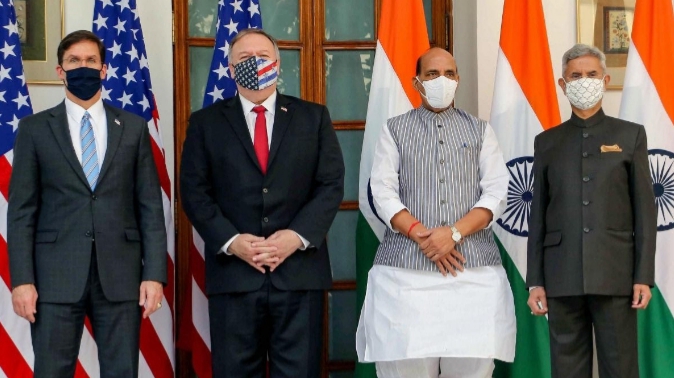
Photo Source: PTI
USA is the top export destination for India (~17%) which is also reflected in exchange of goods through postal channel. In 2019, around 20% of outbound EMS and 30% of Letters & Small Packets transmitted by India Post were destined to USA whereas 60% of the Parcels received by India Post were originated from USA. Exchange of Electronic Advance Data (EAD) as per the Agreement will be a key driver towards promoting mutual trade with emphasis on the exports from different parts of India to USA through postal channel considering that USA is a major destination of MSME products, Gems &Jewelry, Pharmaceuticals and other local products from India. This will fulfill a major demand of export industry to expedite customs clearances of export items.
The primary objective that will be served by this agreement is to facilitate ‘ease of exports’ for small and large exporters through postal channels from different parts of the country and will contribute towards making India an Export Hub for the world.
The agreement was signed by Mr. Prannoy Sharma, Deputy Director General (International Relations & Global Business), Department of Posts, Government of India and Mr. Robert H. Raines Jr., Managing Director, Global Business of United States Postal Service.
Read More ->>
Ministry of Home Affairs (MHA) extends the Guidelines upto November 30, 2020
Ministry of Home Affairs (MHA) extends the Guidelines upto November 30, 2020
Ministry of Home Affairs
MHA extends the Guidelines for Re-opening
Moving ahead with caution (सतर्कता के साथ अग्रसर)
States/ UTs advised to enforce COVID-Appropriate behavior
27 OCT 2020
Ministry of Home Affairs (MHA) issued an Order today to extend the Guidelines for Re-opening, issued on 30.09.2020, to remain in force upto 30.11.2020
Re-opening of activities outside the Containment Zones
Since the issuance of the first Order on lockdown measures by MHA on 24th March 2020, almost all activities have been gradually opened up in areas outside the Containment Zones. While most of the activities have been permitted, some activities involving large number of people, have been allowed with some restrictions and subject to SOPs being followed regarding health and safety precautions. These activities include – metro rail; shopping malls; hotel, restaurants and hospitality services; religious places; yoga and training institutes; gymnasiums; cinemas; entertainment park etc.
In respect of certain activities, having relatively higher degree of risk of COVID infection, State/ UT Governments have been permitted to take decisions for their re-opening, based on the assessment of the situation and subject to SOPs. These activities include – schools and coaching institutes; State and private universities for research scholars; allowing gatherings above the limit of 100 etc.
After the last guidelines issued by MHA on 30.09.2020, the following activities are also permitted but with certain restrictions:
- International air travel of passengers as permitted by MHA.
- Swimming poolsbeing used for training of sportspersons.
- Exhibitions halls for Business to Business (B2B) purposes.
- Cinemas/ theatres/ multiplexes upto 50% of their seating capacity.
- Social/ academic/ sports/ entertainment/ cultural/ religious/ politicalfunctions and other congregations, in closed spaces with a maximum of 50% of the hall capacity and subject to ceiling of 200 persons.
Further decision regarding the above activities will be taken based on the assessment of the situation
COVID-Appropriate behavior
The essence behind graded re-opening and progressive resumption of activities is to move ahead. However, it does not mean the end of the pandemic. There is a need to exercise abundant caution by adopting COVID-19 appropriate behavior by every citizen in their daily routine. A ‘Jan Andolan’ was launched by the Prime Minister, Shri Narendra Modi on 8th October 2020 on COVID-19 appropriate behavior to follow three mantras, namely:
- wear your mask properly;
- wash your hands frequently; and
- maintain safe distance of 6 feet.
- There is an urgent need to instill a sense of discipline and ownership amongst citizens in order that the resumption of activities is successful and gains made in the management of the pandemic are not diluted.
- MHA has already advised Chief Secretaries/ Administrators of all States/ UTs that they should endeavour to promote COVID-19 appropriate behavior extensively at the grass root level and take measures to enforce the wearing of masks, hand hygiene and social distancing.
National Directives for COVID-19 management
- National Directives for COVID-19 management shall continue to be followed throughout the country, so as to enforce COVID-19 appropriate behavior.
Strict enforcement of lockdown in Containment Zones till 30th November 2020
- Lockdown shall continue to be implemented strictly in the Containment Zones till 30th November, 2020.
- Containment Zones shall be demarcated by the District authorities at micro level after taking into consideration the guidelines of MoHFW with the objective of effectively breaking the chain of transmission. Strict containment measures will be enforced in these containment zones and only essential activities will be allowed.
- Within the containment zones, strict perimeter control shall be maintained and only essential activities allowed.
- These Containment Zones will be notified on the websites of the respective District Collectors and by the States/ UTs and information will also be shared with MOHFW.
States not to impose any local lockdown outside Containment Zones
- State/ UT Governments shall not impose any local lockdown (State/ District/ sub-division/City/ village level), outside the containment zones, without prior consultation with the Central Government.
No restriction on Inter-State and intra-State movement
- There shall be no restriction on inter-State and intra-State movement of persons and goods.No separate permission/ approval/ e-permit will be required for such movements.
Protection for vulnerable persons
- Vulnerable persons, i.e., persons above 65 years of age, persons with co-morbidities, pregnant women, and children below the age of 10 years, are advised to stay at home, except for meeting essential requirements and for health purposes.
Use of AarogyaSetu
The use of AarogyaSetu mobile application will continue to be encouraged.
Source: PIB
Read More ->>
Issue of 8.50% Government of India (National Small Savings Fund) (Non-transferable) Special Securities, 2019
Issue of 8.50% Government of India (National Small Savings Fund) (Non-transferable) Special Securities, 2019
MINISTRY OF FINANCE
(Department of Economic Affairs)
NOTIFICATION
New Delhi, the 12th October, 2020
No. 5/1/2019-NS – In exercise of the powers conferred by clause (f) of Section 2 of the Government Securities Act, 2006 (38 of 2006), the Central Government hereby specifies that
(i) 8.50% (Eight point five percent) Government of India (National Small Savings Fund) (Non-transferable)Special Securities, 2019 have been issued in FY 2019-20 in the form of ‘Stock’ to be held at the credit of the holder in the Subsidiary General Ledger Account maintained by the Public Debt Office; and
(ii) These securities shall not be transferable.
RAJAT KUMAR MISHRA, Jt. Secy.
NOTIFICATION
New Delhi, the 12th October, 2020
Issue of 8.50% Government of India (National Small Savings Fund) (Non-transferable) Special Securities, 2019
No. 5/1/2019-NS.—The Government of India, hereby notifies the issue of 8.50 per cent Government of India(National Small Savings Fund) (Non-transferable) Special Securities, 2019 (hereinafter called “special securities”).
2. Objective:
Consequent upon the creation of a new fund in the Public Account of India called the “National Small Savings Fund” (NSSF), the Central Government has issued the Special Securities notified here under against the amounts received by the Government from NSSF from time to time.
3. Eligibility for subscribing to special securities:
The Secretary, Government of India, Ministry of Finance, Department of Economic Affairs, shall be eligible to subscribe to special securities for the amounts invested by NSSF as specified by the Central Government from time to time.
4. Subscription:
Special securities have been issued for an amount of Rs.1,00,000 (face value) and in multiples of Rs.1,00,000thereafter.
5. Form of securities:
The special securities have been issued in the form of ‘Stock’ to be held at the credit of the holder in the Subsidiary General Ledger Account maintained with Public Debt Office, Reserve Bank of India, Nagpur.
6. Price, Date and Place of Issue:
(i) The special securities have been issued at par.
(ii) The date of issue of special securities shall be date of credit of special securities to the Subsidiary General Ledger Account of NSSF.
(iii) The Special Securities will be issued at Public Debt Office, Reserve Bank of India, Nagpur.
7. Tenure:
The tenure of the special securities will be 10 years from the date of issue.
8. Interest:
(i) The special securities bear interest at the rate of 8.50% (Eight point five per cent.) per annum which will be payable at half yearly basis reckoned from the date of issue of the special securities. Interest on the securities will be payable at the Public Debt Office (i.e. the office of Issue), Reserve Bank of India, Nagpur.
(ii) Interest will be paid after rounding off to nearest hundred rupees.
9. Repayment:
The special securities shall be repayable in ten equal annual installments starting from the next year from the date of issue.
10. Transferability and conversion:
The Special Securities shall not be transferable and conversion of the securities to any other form shall not be permitted, until and unless otherwise specified by the Government.
11. Statutory Provisions:
With respect to any such matter which has not been provided under this notification, the special securities shall be governed by the Government Securities Act, 2006 (38 of 2006).
RAJAT KUMAR MISHRA, Jt. Secy.
NOTIFICATION
New Delhi, the 12th October, 2020
No. 5/1/2019-NS-In exercise of the powers conferred by clause (f) of Section 2 of the Government Securities Act, 2006 (38 of 2006), the Central Government hereby specifies that
(i) 8.50% (Eight point five percent) Government of India (National Small Savings Fund) (Nontransferable)Special Securities, 2030 have been issued in FY 2019-20 in the form of ‘Stock’ to beheld at the credit of the holder in the Subsidiary General Ledger Account maintained by the Public Debt Office; and
(ii) These securities shall not be transferable.
RAJAT KUMAR MISHRA, Jt. Secy.
NOTIFICATION
New Delhi, the 12th October, 2020
Issue of 8.50% Government of India (National Small Savings Fund) (Non-transferable)
Special Securities, 2030
No. 5/1/2019-NS- The Government of India, hereby notifies the issue of 8.50 per cent Government of India (National Small Savings Fund) (Non-transferable) Special Securities, 2030 (hereinafter called”special securities”).
2. Objective:
Central Government has issued the Special Securities notified hereunder against the amount received in the National Small Savings Fund (NSSF) on account of redemption of special Government of India and State Government securities issued against shares of net small savings collection from 1-4-1999.
3. Eligibility for subscribing to special securities:
The Secretary, Government of India, Ministry of Finance, Department of Economic Affairs, on behalf of NSSF, shall be eligible to subscribe to special securities.
4. Subscription:
Special securities have been issued for an amount of Rs.1,00,000 (face value) and in multiples of Rs.1,00,000 thereafter.
5. Form of securities:
The special securities have been issued in the form of ‘Stock’ to be held at the credit of the holder in the Subsidiary General Ledger Account maintained with Public Debt Office, Reserve Bank of India, Nagpur.
6. Price, Date and Place of Issue:
(i) The special securities have been issued at par.
(ii) The date of issue of special securities shall be date of credit of special securities to the Subsidiary General Account of NSSF .
(iii) The Special Securities will be issued at Public Debt Office, Reserve Bank of India, Nagpur.
7. Tenure:
The tenure of the special securities will be 10 years from the date of issue.
8. Call and put option:
(i) The Special Securities will have call and put option as specified in paragraph 7.5 of the General Notification, issued vide this Department’s F.No.4(2)-W&M/2018, dated 27th March, 2018.
(ii) The Government of India shall have the discretion to exercise “call option” to prematurely redeem the special securities wholly or partly at par, after two years. In that event, interest on thespecial securities shall cease to accrue on the redeemed special securities from the date of premature redemption decided by the government.
(iii) The holder of the Special Securities, i.e. National Small Savings Fund shall have the discretion to exercise “put option”, for premature redemption of the special securities, wholly or partly at par,after two years. In that event, interest on the special securities shall cease to accrue on the redeemed special securities from the date of premature redemption.
9. Interest:
(i) The special securities bear interest at the rate of 8.50% (Eight point five per cent.) per annum payable on half-yearly basis. Interest on the securities will be payable at the Public Debt Office(i.e. the office of Issue), Reserve Bank of India, Nagpur.
(ii) Interest will be paid after rounding off to nearest hundred rupees.
10. Repayment:
The special securities shall be repaid at par after ten years i.e. in FY 2029-30 on the same day of issue subject to the terms specified under paragraph 8 here in above.
11. Transferability and conversion:
The Special Securities shall not be transferable and conversion of the securities to any other form shall not be permitted, until and unless otherwise specified by the Government.
12. Statutory Provisions:
With respect to any such matter which has not been provided under this notification, the special securities shall be governed by the Government Securities Act, 2006 (38 of 2006).
RAJAT KUMAR MISHRA, Jt. Secy.
Read More ->>
Scheme for preparation, maintenance and custody of lists of public servants of gazetted status of doubtful integrity
Scheme for preparation, maintenance and custody of lists of public servants of gazetted status of doubtful integrity
Secret
No: 105/1/66-AVD-I
Government of India
Ministry of Home Affairs
New Delhi- 1, the 28th October, 1969
6th Kartika, 1891
OFFICE MEMORANDUM
Subject:- Scheme for preparation, maintenance and custody of lists of public servants of gazetted status of doubtful integrity.
The undersigned is directed to enclose a copy of the scheme mentioned above with the request that appropriate action may kindly be taken as indicated therein.
2. The revised lists prepared in accordance with the enclosed scheme will supersede the lists circulated to Secretariat by the Director, Central Bureau of Investigation on with his D.O. letter No. 21/7/63-GD, dated the 7th May, 1964.
3. The revised lists prepared in accordance with the enclosed scheme will not affect the continuance of the . annual agreed lists of suspected officers which are being prepared in accordance with para 6 to l0 of the programme for vigilance and anti-corruption work during 1966 circulated ·with this Ministry ‘s 0.M. No. 130/1/66-AVD, dated the the May 1966 (as continued from time to time)
5. Receipt of this communication may kindly be acknowledged.
Sd/-
R.C.Joshi
Under Secy. to the Govt. of India
To
All Chief Vigilance Officers
of Ministries/Departments.
No. 105/1/66-AVD, dated the 28th October, 1969.
Copy with a copy of the scheme forwarded to:
Chief Secretaries of all Union Territories for similar action in so far as they are concerned; and
Director, Central Bureau of Investigation(Shri D.Sen, Joint Director, Special IGP), New Delhi.
Sd/- R.C.Joshi
Under Secy. to the Govt. of lndia
SECRET
SCHEME FOR PREPARATION, MAINTENANCE AND CUSTODY OF LIST OF PUBLIC SERVANTS OF GAZETTED STATUS OF DOUBTFUL INTEGRITY
INTRODUCTION-
- In accordance with the recommendation made in the statement laid on the Table of the Lok Sabha on the 10th August, 1961, and the Rajya Sabha on the 24th August, 1961 measures are to be taken to locate officials against whom suspicions exist regarding their integrity amount to moral conviction. It has already been decided that Secretaries to the Ministries and the Heads of the Departments have the duty of locating and suitably dealing with corrupt officials. . As a further step in this direction, it has been decided to prepare lists of public servants of gazetted status of doubtful integrity. This scheme gives in detail the purpose of these lists and procedure for their preparation and maintenance.
NOMENCLATURE & CRITERIA FOR ENTRY IN THE LISTS –
2. The lists will be termed as the ‘list of Public Servants of Gazetted status of Doubtful Integrity ‘. It will include names of those officers only who, after enquiry or during the course of enquiry, have been found to be lacking in It will thus include the names of the officers, with certain exceptions mentioned below, falling under one of the following categories:
- Convicted in a court of law on a charge of lack of integrity or for an offense involving moral turpitude but on whom, in view of exceptional circumstances, a penalty other than dismissal, removal or compulsory retirement is
- Awarded departmentally a major penalty.
- on charges of lack of integrity
- on charges of gross dereliction of duty in protecting the interests of Government although the corrupt motive may not be capable of
- Against whom proceedings for a major penalty or a court trial are in progress for alleged acts involving lack of integrity or moral turpitude.
- Who were prosecuted but acquitted on technical grounds, and in whose case on the basis of evidence during the trial there remained a reasonable suspicion against their integrity.
The names of the officers of the following categories should not be included in this list.:
- Officers who have been cleared or honourably acquitted as a result of disciplinary proceedings or court trial.
- Officers against whom an enquiry or investigation has not brought forth sufficient evidence for recommending even a disciplinary case.
- Officers who have been convicted of offences not involving lack of integrity or moral turpitude.
- Officers against whom disciplinary proceedings have been completed or are in progress in respect of administrative lapses, minor violation of Conduct Rules and the like.
PURPOSE OF THE LISTS .
3. These lists are intended to keep the Ministries/Departments/ Undertakings concerned informed about such officers of doubtful integrity to ensure that they are not posted to ‘sensitive’ assignments and that this fact is given due consideration when deciding administrative mtters affecting the service of these These lists would also help the Ministries to know about the officers whose work a,nd conduct need both special attention and closer supervisory scrutiny.
PROCEDURE FOR PREPARATION OF THE LISTS
4. (i) Vigilance Organisation o( Ministries/Departments/ Undertakings will prepare a list of public servants of Gazettted status against whom any disciplinary proceedings for a major penalty are in progress or who have been punished in disciplinary proceedings on a charge involving lack of integrity. A copy of these lists will be sent by the vigilance Organisation to the Central Bureau of Investigation every year in the last week of February.
(ii) As soon as an adverse report against an officer of the nature mentioned in the scheme is received, the Vigilance Officer should bring it to the notice of the Secretary/Head of the Ministry/Department concerned immediately. A decision in regard to the inclusion of the name of such officer in the list should be taken as soon as possible.
(iii) The Central Bureau of Investigation will suggest addition or deletion of names on the basis of information available with them and return the lists to Secretaries/Heads of Departments concerned.
(iv) If the Ministry/Department/Public Undertakings concerned does not agree to the inclusion or deletion of any particular name or names, it will be settled by mutual discussion. The decision of the Secretary/Head of the Ministry/Department would be final.
ACTION OF THE LISTS
- The purpose of maintenance of these lists is to also enable the Ministries/Departments to take such administrative action as is necessary and The following courses of administrative action are open:-
- Withholding Certificate of integrity;
- Transfer from a ‘sensitive’ posts;
- Non-promotion , after consideration of his case, to a service, grade or post to which he is eligible for promotion,
- Compulsory retirement in the pu blic interest (otherwise than as penalty) in accordance with the orders issued by the Government. This is now permissible on completion of the age of 50 with certain exceptions.
- Refusal of extension of service or re-employment either under Government or in a Public Sector undertakings.
- Non-sponsoring of names for foreign assignment/deputation.
- Refusal of permission for commercial re-employment after retirement.
- The orders of Government that provide for these administrative measures under certain conditions are:-
(i) Papers on measures for strengthening of administration, particularly paragraph 3 (11) of the statement laid in the Lok Sabha on 10 August, 1961 that corrupt officials should be located and action taken to improve them or retire them.
(ii) Note 1 under article 465-A, Civil Services Regulations, under which Government retain an absolute right to retire certain officers after they have completed 25 years, qualifying service without assigning any reasons.
(iii) Rule 2(2), Liberalised Pension Rules, permits retirement of an officer who has completed 30 years of qualifying service.
(iv) M.H.A. O.M. No. 33/18/62-Ests.(A), dated 30-11-62 raising the age of compulsory retirement from 55 years to 58 years which provided that officers who have reached the age of 55 years may be retired after giving three months notice without assigning any reason.
(v) M.H.A. O.M. No. 41/2/55 (II) Ests.(A) dated April, 23, 1965 provides that officers who do not have a reputation for honesty should not be placed in position where there is considerable scope for discretion.
(vi) M.H.A. O.M. No. 1/7/64-Ests (D), dt. July 30, 1964 provides that particular attention should be given to integrity when considering officers for promotion. It also provides for the recording of a certificate of integrity when sponsoring a name for promotion.
(vii) M.H.A. O.M. NO. 33/11/64-Ests (A), dt. September 11, 1964 requires that an officer, who does not have a good reputation for integrity, should not be considered eligible for grant of extension/re-employment in service.
(viii) H.A . letter No. 29/67/66-AIS(II) dt. 5-9-67 regarding premature retirement of A.LS. officers under Rule 16 (3) of the AIS (D.C.R.B.) Rules.
(ix) M.H.A. O.M. NO. 20/22/68-Ests (A) dt. 6-5-69 and O.M. No. 33/ 13/61-Ests (A) dt. 23-6-69.
(x) M.H.A. O.M. No. 39/17/63-Ests (A), dt. 6-9-69.
- When the name of an officer has been entered in the list for good and adequate reasons, it will not be removed until a period of three years has The period of three years for which. the name will be current on the list will count from the date of punishment in disciplinary proceedings or from the date of conviction in a court trial. On the conclusion of this period the cases of such officers may be reviewed by the Ministry/Department concerned in consultation with the Central Bureau of Investigation and if during the intervening period there has been no further complaint or information against the officer touching on his integrity, the name may be removed from the list. If at the time of review, it is proposed to continue the name of an officer on the list, cogent reason for doing so should exist.
TRANSFER OF SUCH OFFICERS
- In the event of the officers being transferred to another Ministry/Department/Undertakings, the Vigilance Officer concerned should intimate to his opposite number in the Ministry/ Department/ Undertaking the fact of the officer’s name being on the list, endorsing a copy to the Central Bureau of Investigation.
PERIODICITY OF CIRCULATION BY THE C.B.l.
- Lists of such officers consolidated by the Central Bureau of Investigation will be circulated to Ministries once every year i.e. in June. While communicating the name of the officer the material against him should be briefly indicated- by the Central Bureau of Irtvestigation . Five copies of the list covering all Ministries/ Deprutments/Undertakings will be sent to the Ministry of Home Affairs(AVD), four copies for the use of E.O., J.S(E), J.S.(P), J.S.(AIS) and one for record on the AVD communication and references should be directly between the Central Bureau of Investigation and the Ministry concerned.
MAINTENANCE & CUSTODY OF THE LISTS
- It will be the duty of the Chief Vigilance Officer Nigilance Officer of the Ministry/Department/Undertaking to maintain these lists uptodate, The list will be treated as ‘SECRET’ and the Head of the Ministry/Department/Undertaking will be responsible for its safe custody.
- The lists cannot be and are not meant to be fully exhaustive and these will not fetter the discretion of the Government In any
Read More ->>
DoPT reforms regarding Child Care Leave
DoPT reforms regarding Child Care Leave
DoPT reforms regarding Child Care Leave
Posted On: 26 OCT 2020 7:11PM by PIB Delhi
While briefing about some of the major reforms brought by Department of Personnel & Training (DoPT) under the Modi government, Union Minister of State (Independent Charge) Development of North Eastern Region (DoNER), MoS PMO, Personnel, Public Grievances, Pensions, Atomic Energy and Space, Dr Jitendra Singh said today that the male employees of the government are also now entitled to Child Care Leave.
However, Dr Jitendra Singh said that the provision and privilege of Child Care Leave (CCL) will be available only for those male employees who happen to be “single male parent”, which may include male employees who are widowers or divorcees or even unmarried and may therefore, be expected to take up the responsibility of child care as a single - handed parent.
Describing it as a path-breaking and progressive reform to bring ease of living for government servants, Dr Jitendra Singh said, the orders regarding this had been issued quite some time back but somehow did not receive enough circulation in the public.
In a further relaxation to this provision, Dr Jitendra Singh informed that an employee on Child Care Leave may now leave the head quarter with the prior approval of Competent Authority. In addition, the Leave Travel Concession (LTC) may be availed by the employee even if he is on Child Care Leave. Elaborating further, he informed that Child Care Leave can be granted at 100% of leave salary for the first 365 days and 80% of leave salary for the next 365 days.
Based on the inputs over a period of time, Dr Jitendra Singh said, another welfare measure introduced in this regard is that in case of a disabled child, the condition of availing Child Care Leave up to the age of 22 years of the child has been removed and now Child Care Leave can be availed by a government servant for a disabled child of any age.
With the personal intervention and indulgence of Prime Minister Sh Narendra Modi and his special emphasis on governance reforms, Dr Jitendra Singh said, it has been possible to make several out-of-box decisions in the DoPT over the last six years. Basic purpose behind all these decisions has always been to enable a government employee to contribute to the maximum of his potential, although at the same time there will be no leniency or tolerance toward corruption or non-performance, he said.
Read More ->>
SOP for LDCE for promotion to PS Group-B, scheduled to be held on 29.11.2020
Oct 27, 20200 comments

Read More ->>
Remuneration to Casual Labourers
Remuneration to Casual Labourers
Remuneration to Casual Labourers

Read More ->>

 →


