Monday, 31 July 2017

SBI cuts interest rate on savings account deposits

SBI cuts interest rate on savings account deposits

(State Bank of India) has cut interest rate on savings bank accounts to 3.5 per cent from 4 per cent on balance of Rs 1 crore and below, the country's largest public sector lender informed the stock exchanges on Monday in a regulatory filing. About 90 per cent of SBI's savings bank accounts have balances under Rs 1 crore.


"The decline in the rate of inflation and high real interest rates are the primary considerations warranting a revision in the rate of interest on savings bank deposits," SBI said in a statement.


The change in the structure is effective immediately and also marks the introduction of a new two-tier savings account interest rate system as balance of over Rs 1 crore will continue to attract the earlier 4 per cent rate. Analysts and markets see the bank's move as a positive and believe the 0.5 per cent cut in savings bank deposits will aid in boosting SBI's margins. SBI almost always leads the rate cut cycle with other banks following suit. Analysts expect the same to happen with Monday's interest rate cut.


Post the announcement, the SBI stock shot up nearly 5 per cent to Rs 312.65, while the broader Nifty traded flat.


SBI also informed the bourses that it had cut the MCLR (marginal cost of funds based lending rate) or its key lending rate, by 90 basis points effective January 1, 2017, on the strength of large inflows in savings and current accounts after demonetisation. "There has been significant outflow of CASA (current account and savings account) deposits. The revision in savings bank rate would enable the bank to maintain MCLR at the existing rates, benefitting a large segment of retail borrowers in SME, agriculture and affordable housing segments," SBI said
During demonetisation Rs 1.5 lakh crore had flown into savings accounts between November and December 2016, SBI said on a conference call post the announcement. The Narendra Modi government in a surprise move on November 8, 2016, had outlawed old notes of Rs 500 and Rs 1,000 denomination in a bid to curb black money.


SBI's rate cut on Monday comes just two days ahead of the Reserve Bank of India's (RBI) monetary policy meet on Wednesday where most analysts expect India's central bank to cut key interest rates. A significant moderation in retail inflation over the past few months has reinforced calls for further monetary policy easing from the RBI which has stayed status quo on rates despite appeals from the Finance Ministry and the industry at large.

Read More ->>
Deadline for I-T return extended till August 5

Deadline for I-T return extended till August 5

income tax returns, income tax filing, income tax returns last date, it returns last date, how to file income tax, india news, Indian Express India news, business, India news
The government on Monday extended the deadline for filing the Income Tax Returns (ITRs) for the financial year 2016-17. The new deadline has been set at August 5.


The announcement was made by the the Income Tax department's verified Twitter handle. The I-T department cited 'difficulties faced by taxpayers' as the reason behind the extension.
This comes after news agency PTI on Sunday had quoted a top official saying that there will be no extension beyond July 31 in the last date for filing of ITR.

"The last date for filing of ITRs remains July 31. There are no plans to extend this deadline. The department has already received over 2 crore returns filed electronically. The department requests taxpayers to file their return in time," the official had said.

On reports of the e-filing website facing some glitches, the official said that no major glitches have been reported with the department's e-filing website - http://incometaxindiaefiling.gov.in/ - barring a few times when the portal was "interrupted for maintenance".

However, many taxpayers were facing difficulty in filing their returns and they complained of facing problems in the website even on Monday.


The department had also issued advertisements in leading national dailies in the last few days stating that taxpayers should disclose their income "correctly" and file their ITRs on or before July 31.

The linking of Aadhaar number with the PAN(Permanent Account Number) of a taxpayer has also been made mandatory for filing of an ITR, beginning July 1.


The department has also asked taxpayers to declare cash deposits made in bank accounts aggregating to Rs 2 lakh or more, post demonetisation between November 9-December 30 last year, in the ITRs.
Read More ->>

Serving employees /Pensioners of Union Territories are not entitled to CGHS facilities.

Serving employees /Pensioners of Union Territories are not entitled to CGHS facilities.

Read More ->>

7th Pay Commission: Govt employees to get revised salary from tomorrow, but will there be no 8th Pay?

7th Pay Commission: Govt employees to get revised salary from tomorrow, but will there be no 8th Pay?

7th Pay Commission: Govt employees to get revised salary from tomorrow, but will there be no 8th Pay?

After waiting for over an year, the central government employees will get their revised salary under 7th Pay Commission starting from tomorrow. 
48 lakh employees will see their higher allowance from July as Government asked central ministries and department to ensure the revised rates of allowances under 7th Pay Commission are paid immediately. 
On July 7, Government of India issued a notification regarding 7th Pay Commission by publishing it in the Gazette of India.  
While the central government employees are still dissatisfied with the revised allowances, this salary revision will be for the last time as the government is planning to not form any pay commission post this. Which means, there are chances of no 8th Pay Commisison. 
Modi-government is also likely to take policy decision on the same, as reported by The Sen Times which quoted a Ministery of Finance official. 
The reason could be the additional burden, the implementation of 7th Pay Commission will put on country's finances. Finance Minister Arun Jaitley, last year had mentioned "The Pay Commission has put a burden of Rs 1.03 lakh crore in respect of pay and allowances."
On June 28, while approving the recommendations under 7th CPC, the Ministry of Finance had mentioned, "The modifications approved by the Government in the recommendations of the 7th CPC on allowances will lead to a modest increase of Rs 1448.23 crore per annum over the projections made by the 7th CPC. The 7th CPC, in its Report, had projected the additional financial implication on allowances at Rs 29,300 crore per annum. The combined additional financial implication on account of the 7th CPC recommendations along with the modifications approved by the Cabinet is estimated at Rs 30748.23 crore per annum."
The employees have been showing "dissatifaction" with the government on revised allowance from past one month. 
The Cabinet had said that house rent allowance (HRA) which is currently paid 30% for X (population of 50 lakh & above), 20% for Y (5 to 50 lakh) and 10% for Z (below 5 lakh) category of cities. 7th CPC has recommended reduction in the existing rates to 24% for X, 16% for Y and 8% for Z category of cities. 
However, the central government employees in a meeting with government officials said they are not happy by the decision. They reiterated for retaining the existing HRA rates at 30%, 20% and 10%.
Read More ->>

Central Government to Launch Crackdown on Corrupt Officials From August 15

Central Government to Launch Crackdown on Corrupt Officials From August 15

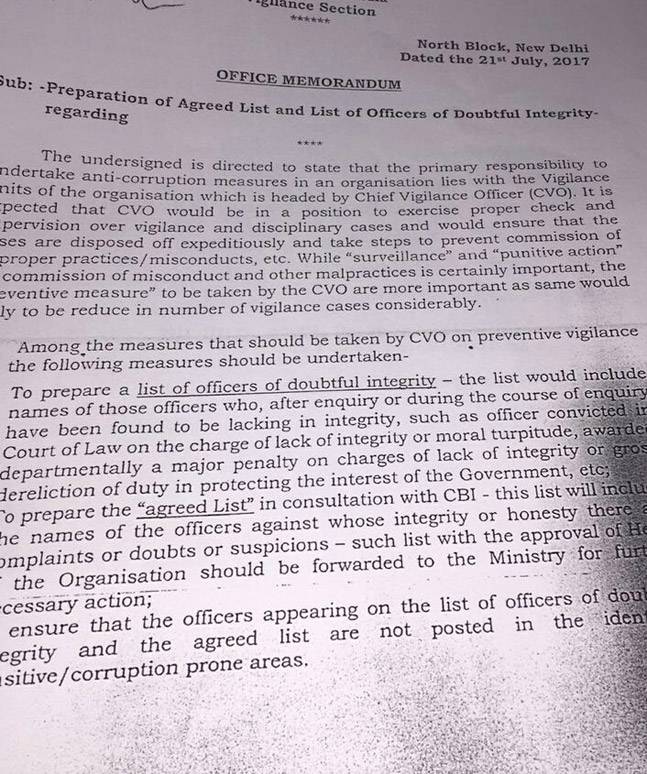
Prime Minister Narendra Modi has time and again claimed that corruption has come down since he took charge and that providing graft-free rule is on top of his priority. Now, to further polish its taint-free image, the government is preparing a crackdown on corrupt officials.
According to a government notification available, the vigilance department of each ministry has been asked to prepare a dossier of tainted and corrupt officials.

WHAT YOU NEED TO KNOW:

1. The Home Ministry is preparing the dossier based on service records of the officials.
2. The ministry has written letters to various departments and all the para military forces to finish the list by August 5, so that further action is initiated.
3. Dossier of corrupt officials and employees will be based on the complaint, enquiry report and conduct of the officials, moral turpitude, dereliction of duty in protecting the interest of the government. It will also examine whether major or minor penalty was imposed against the particular official or not.
4. List/dossier of corrupt officials will be approved by the competent authority.
5. Their actions and decisions will be examined to see if they are causing loss to the government for personal benefits.
6. The list will be sent to CBI and CVC, who will monitor the conduct of tainted officials and keep close watch on such officials and take necessary action to prosecute, or recommend departmental action including major penalty, demotion or even dismissal from service.
7. Sources said once list/dossier is ready action against or crackdown will start after August 15.
RULES TO PROBE CORRUPTION CASES AMENDED
Changing an over 50-year-old rule, the government in June set a deadline of six months to complete probe in corruption cases involving its employees
The decision has been taken to speed up the investigation in such cases, most of them pending for quiet a long time
The Department of Personnel and Training (DoPT) has amended Central Civil Services (Classification, Control and Appeal) Rules, 1965, and decided time-line for critical stages of investigation and enquiry proceedings.
The Inquiring Authority should conclude the inquiry and submit its report within a period of six months, says the amended rules.
However, an extension for a period not exceeding six months at a time may be allowed for any good and sufficient reasons to be recorded in writing by the disciplinary authority, it said
Earlier, there was no time-frame to complete an enquiry.
Source: PTI
Read More ->>

Bureaucrats are Free to Render Their Advice/Opinion During the Process of Decision Making -Jaitley

Bureaucrats are Free to Render Their Advice/Opinion During the Process of Decision Making -Jaitley

The Union Minister of Finance, Defence and Corporate Affairs, Shri Arun Jaitley said that the bureaucrats are free to render their advice/opinion during the process of decision making. He said that however, the Right to Information (RTI) Act can to some extent create hindrance in this regard and the civil servants may not feel free to do so apprehending that the later the same may become public.
That’s why, the Finance Minister said that even Shri B.G.Verghese had stated that the opinion/advice given by public servants in the course of decision making should not be made public. The Finance Minister Shri Jaitley was speaking after releasing a book entitled “I@S – TALE TOLD BY AN IASs” written by Shri Omesh Saigal, a retired Officer of the Indian Administrative Service (1964 Batch) at a function here in North Block in the national capital today.
Earlier speaking on the occasion, Shri Tejinder Khanna, former civil servant and Lt. Governor of Delhi said that the bureaucrats should be allowed to give their opinion in a free and fair manner so that the good suggestions are not left –out in the process of decision making.
Shri Omesh Saigal, the author of the book said that in his book, he has shared his different experiences in the course of his service and how the service like IAS has evolved over a period of time.
Large number of senior serving and retired civil servants were present on the occasion.
Source:PIB

Read More ->>

7th Pay Commission: Millions Of Central Employees Unhappy With Current Allowances Hike

7th Pay Commission: Millions Of Central Employees Unhappy With Current Allowances Hike

New Delhi: Millions of central government employees are currently unhappy with their allowances hike under the 7th Pay Commission recommendations.
FM Jaitley had said in the Parliament in August 2016, “The Pay Commission has put a burden of Rs 1.03 lakh crore in respect of pay and allowances.” but he didn’t give arrears on allowances, which also included in this figure.
It seems that nobody is satisfied with their allowances hike. At every level there appears to be an upward pressure on salaries and allowances, everyone deserve more pay and allowances than 7th Pay Commission recommendations.
The current allowances hike has got recent media attention, while, at the other end, there has been debate about the hiking of pay and allowances on the recommendations 7th Pay Commission are proper or not.
The 7th Pay Commission slashed down House Rent Allowance (HRA), which constitutes a substantial part of central government employees’ salaries. The Commission had recommended HRA at the rate of 24 per cent, 16 per cent and 8 per cent of basic pay of the central government employees and the government stuck with the 7th Pay Commission’s recommendations on HRA and gave nod accordingly.
While The previous 6th Pay Commission had recommended HRA at the rate of 30 per cent, 20 per cent and 10 per cent for X, Y and Z category of cities respectively.
There had been widespread demand from central government employee unions to hike HRA at the rate of 30 per cent, 20 per cent and 10 percent of basic pay.
The hike in HRA, which gives more money in the pockets of the employees, that’s compensatory perks for all central government employees, which has been paid from July 1 and no arrears for allowances are being paid, as per usual practice, the allowances are paid from the date of implementation. This also a cause of unhappiness in central government employees.
All pay commissions except 7th Pay Commission made up pay gap in respect of basic pay between lower paid employees and top bureaucrats from second Pay Commission 1:41 ratio to Sixth pay commission 1:12.
The first pay commission was recommended pay of the top bureaucrats 41 times higher than the government employees at the bottom. The top bureaucrats were given salary Rs 2,263 while the lowest earning employees got Rs 55.
Subsequent pay commissions reduced the ratio of pay between lowest earning employees and top bureaucrats from 1:41 in 1947 to about 1:12 in 2006, while 7th Pay Commission made it higher about to 1:14.
The 7th Pay Commission recommended a minimum basic pay for Central government employees of Rs 18,000 with a maximum pay of Rs 2.50 lakh per month.
The recommendations of the 7th Pay Commission got the Cabinet nod on June 29, 2016 in respect of basic pay, the pay panel had recommended a 14.27 per cent hike in basic pay — the lowest in 70 years. The previous 6th Pay Commission had recommended a 20 per cent hike, which the government doubled while implementing it in 2008.
After 18 to 19 months have passed since the 7th pay commission report was submitted and 12 months have elapsed since the union cabinet approved the 7th Pay Commission recommendations for hike in basic pay of central government employees, the Cabinet approved the recommendations on allowances on June 28 this year, which are being paid to the employees from this this month without arrears.
The central government employee unions expressed their resentment over the announcement of non payment of arrears on allowances. They demanded arrears on HRA from January, 2016.
Finance Minister Arun Jaitley had said in the Parliament in August 2016, “The Pay Commission has put a burden of Rs 1.03 lakh crore in respect of pay and allowances.” but he didn’t give arrears on allowances, which also included in this figure.
TST
Read More ->>

Anomaly Committee

Anomaly Committee

W


Read More ->>

File ITR by July 31, no extension proposed: Income Tax Dept

File ITR by July 31, no extension proposed: Income Tax Dept


New Delhi, Jul 30 (PTI) The last date for filing of Income Tax Returns (ITRs) for the financial year 2016-17 will not be extended beyond tomorrow's deadline, a top official today said.

"The last date for filing of ITRs remains July 31. There are no plans to extend this deadline. The department has already received over 2 crore returns filed electronically.
The department requests taxpayers to file their return in time," the official said.

On reports of the e-filing website facing some glitches, the official said that no major glitches have been reported with the department's e-filing website-- http://incometaxindiaefiling.gov.in/--barring a few times when the portal was "interrupted for maintenance".

The department has also issued advertisements in leading national dailies in the last few days stating that taxpayers should disclose their income "correctly" and file their ITRs on or before July 31.

The linking of Aadhaar number with the PAN (Permanent Account Number) of a taxpayer has also been made mandatory for filing of an ITR, beginning July 1.

The department has also asked taxpayers to declare cash deposits made in bank accounts aggregating to Rs 2 lakh or more, post demonetisation between November 9-December 30 last year, in the ITRs.

The ITRs to be filed by July 31 pertain to 2016-17 fiscal or assessment year 2017-18.
Read More ->>