Monday, 3 October 2022

Periodic verification of qualifying service under the Central Civil Services (Pension) Rules, 2021 and monitoring at the level of Secretary of the Administrative Ministry/Department: DoP&PW OM No. – 28/90/2022-P&P W(B)/8297 dated 02.10.2022

 Periodic verification of qualifying service under the Central Civil Services (Pension) Rules, 2021 and monitoring at the level of Secretary of the Administrative Ministry/Department: DoP&PW OM No. – 28/90/2022-P&P W(B)/8297 dated 02.10.2022

No. – 28/90/2022-P&P W(B)/8297
Government of India
Ministry of Personnel, Public Grievances and Pensions
Department of Pension and Pensioners’ Welfare

3rd Floor, Lok Nayak Bhavan, Khan Market,
New Delhi, Dated the 2nd October, 2022

OFFICE MEMORANDUM

Subject: Periodic verification of qualifying service under the Central Civil Services (Pension) Rules, 2021 and monitoring at the level of Secretary of the Administrative Ministry/Department.

The undersigned is directed to say that Department of Pension and Pensioners’ Welfare has notified the Central Civil Services (Pension) Rules, 2021 in supersession of the Central Civil Service (Pension) Rules, 1972.

2. In accordance with Rule 30 of the Central Civil Services (Pension) Rules, 2021, on each occasion after a Government servant has completed eighteen years of service and on his being left with five years of service before the date of superannuation, the Head of Office in consultation with Accounts Officer is required to verify the service rendered by such a Government servant, determine the qualifying service and communicate to him, in Format 4, the period of qualifying service so determined.

3. For the purposes of verification of service, the procedure provided in clause (a) of sub-rule (1) of rule 57 is required to be followed. The verification done under Rule 30 shall be treated as final and shall not be reopened except when necessitated by a subsequent change in the rules and orders governing the conditions under which the service qualifies for pension and gratuity.

4, The Rule further provides that a report shall be submitted to the Secretary of the Administrative Ministry/Department by 31st January of each year, giving the details of the Government servants who were required to be issued a certificate of qualifying service during the previous calendar year under sub-rule (1), the details of the Government servants who have actually been issued the said certificate during the said period and the reasons for not issuing the said certificate in the remaining cases.

5. All Ministries/Departments are requested that the above provisions in the Central Civil Services (Pension) Rules, 2021 regarding periodic verification of qualifying service and monitoring at the level of Secretary of the Administrative Ministry/Department under the Central Civil Services (Pension) Rules, 2021 may be brought to the notice of the personnel dealing with the pensionary benefits in the Ministry/Department and attached/subordinate offices thereunder, for strict implementation.

(S. Chakrabarti)
Under Secretary to the Govt. of India

To
All Ministries/Departments/Organisations,
(As per standard list)

Read More ->>

16 - How to interpret the term of misconduct?

 16 - How to interpret the term of misconduct?


Video Link : https://www.youtube.com/watch?v=Uk1jy3AcX_0

Read More ->>

GDS Conduct & Engagement (C&E) Rules 2020 - Video Study materials

GDS Conduct & Engagement (C&E) Rules 2020 - Video Study materials


Video Link : https://youtu.be/-S599toPq2g

Read More ->>

Regularisation of qualified workers appointed against sanctioned posts – Facts/ clarification by DOP&T OM Dt. 7th Oct 2020

 Regularisation of qualified workers appointed against sanctioned posts – Facts/ clarification by DOP&T OM Dt. 7th Oct 2020

No.49014/7/2020-Estt.(C)
Government of India
Ministry of Personnel, PG & Pensions
Department of Personnel & Training

North Block, New Delhi
Dated: 7th October, 2020

OFFICE MEMORANDUM
Subject: Regularisation of qualified workers appointed against sanctioned posts- Uma Devi judgement- facts/clarification- reg.

The undersigned is directed to say that the instructions for Regularisation of qualified workers appointed against sanctioned posts in the light of Hon’ble Supreme Court’s Judgement dated 10.04.2006 in case of Uma Devi were issued vide DoPT’s O.M. No. 49019/1/2006-Estt(C) dated 11.12.2006. The above instructions state that:

“……in the case of Secretary State of Karnataka and Ors. Vs. Uma Devi it was directed that any public appointment has to be in terms of the Constitutional scheme. However, the Supreme Court in para 44 of the aforesaid judgement directed that the Union of India, the State Governments and their instrumentalities should take steps to regularize as a one time measure the services of such irregularly appointed, who are duly qualified persons in terms of the statutory recruitment rules for the post and who have worked for ten years or more in duly sanctioned posts but not under cover of orders of courts or tribunals.

Accordingly a copy of the above judgement is forwarded to all Ministries/Departments for implementation of the aforesaid direction of the Supreme Court.”

2. In this regard, various cases have been received in this department seeking clarifications regarding implementation of the above judgement. Therefore, it has been decided that further important aspects of the judgement dated 10.04.2006 may be enunciated for the purpose of clarity of the judgement. These important points as quoted from the judgement are reproduced below:

i. Equality of opportunity is the hallmark for public employment and it is in terms of the Constitutional scheme only (Para 1).

ii The filling of vacancies cannot be done in a haphazard manner or based on patronage or other considerations (Para 2).

ii, The State is meant to be a model employer and can make appointments only in accordance with the rules framed under Article 309 of the Constitution (Para 5).

iv. Regularization is not and cannot be a mode of recruitment by any State within the meaning of Article 12 of the Constitution of India, or any body or authority governed by a statutory Act or the Rules framed thereunder. Regularization, furthermore, cannot give permanence to an employee whose services are ad hoc in nature. The fact that some persons had been working for a long time would not mean that they had acquired a right for regularization. (Para 27).

v. Any regular appointment made on a post under the State or Union without issuing advertisement inviting applications from eligible candidates and without holding a proper selection where all eligible candidates get a fair chance to compete would violate the guarantee enshrined under Article 16 of the Constitution (Para 30).

vi Wit is a contractual appointment, the appointment comes to an end at the end of the contract (Para 34).

vii. Regularization, if any already made, but not sub judice, need not be reopened based on this judgment, but there should be no further by-passing of the Constitutional requirement and regularizing or making permanent, those not duly appointed as per the Constitutional scheme (Para 44).

viii In cases relating to service in the commercial taxes department, the High Court has directed that those engaged on daily wages, be paid wages equal to the salary and allowances that are being paid to the regular employees of their cadre in government service, with effect from the dates from which they were respectively appointed. The objection taken was to the direction for payment from the dates of engagement. We find that the High Court had clearly gone wrong in directing that these employees be paid salary equal to the salary and allowances that are being paid to the regular employees of their cadre in government service, with effect from the dates from which they were respectively engaged or appointed. It was not open to the High Court to impose such an obligation on the State when the very question before the High Court in the case was whether these employees were entitled to have equal pay for equal work so called and were entitled to any other benefit. They had also been engaged in the teeth of directions not to do so. We are, therefore, of the view that, at pest, the Division Bench of the High Court should have directed that wages equal to the salary that are being paid to regular employees be paid to these daily wage employees with effect from the date of its judgment. Hence, that part of the direction of the Division Bench is modified and it is directed that these daily wage earners be paid wages equal to the salary at the lowest grade of employees of their cadre in the Commercial Taxes Department in government service, from the date of the judgment of the Division Bench of the High Court. Since, they are only daily wage earners, there would be no question of other allowances being paid to them (Para 46).

3. Additionally, it is also stated that vide the judgement of State of Karnataka Vs. M.L Kesari dated 03.08.2010, the Hon’ble Supreme Court had clarified some aspects of the Uma Devi judgement which are pertinent for proper understanding of the said judgement dated 10.04.2006. These aspects brought out in the M.L. Kesari judgement are reproduced as under:

i The employee concerned should have worked for 10 years or more in duly sanctioned post without the benefit or protection of the interim order of any court or tribunal. In other words, the State Government or its instrumentality should have employed the employee and continued him in service voluntarily and continuously for more than ten years.

ii. The appointment of such employee should not be illegal, even if irregular. Where the appointments are not made or continued against sanctioned posts or where the persons appointed do not possess the prescribed minimum qualifications, the appointments will be considered to be illegal. But where the person employed possessed the prescribed qualifications and was working against sanctioned posts, but had been selected without undergoing the process of open competitive selection, such appointments are considered to be irregular.

iii. The employees who were entitled to be considered in terms of Para 53 of the decision in Uma devi, will not lose their right to be considered for regularization, merely because the one-time exercise was completed without considering their cases, or because the six month period mentioned in para 44 of Uma devi has expired. The one-time exercise should consider all daily-wage/adhoc/those employees who had put in 10 years of continuous service as on 10.4.2006 without availing the protection of any interim orders of courts or tribunals. If any employer had held the one-time exercise in terms of para 44 of Uma devi, but did not consider the cases of some employees who were entitled to the benefit of para 44 of Uma devi, the employer concerned should consider their cases also, as a continuation of the one-time exercise. The one time exercise will be concluded only when all the employees who are entitled to be considered in terms of Para 44 of Umadevi, are so considered.

4. It is also clarified that regularisation under Uma Devi judgement was only a one time exercise.

5. It is also emphasized that all concerned administrative authorities should take steps to effectively defend the Court cases on the basis of principles in the Uma Devi judgement and instructions of DoPT within the limitation period without giving any scope to the Courts to decide the cases against the Government on grounds of delay in filing its reply/appeal. Any laxity in the matter to comply with these instructions leading to adverse orders of the Courts shall be viewed seriously inviting disciplinary action in the matter.

(Umesh Kuntar Bhatia)
Deputy Secretary to the Government of India
Telefax: 23094471
Read More ->>

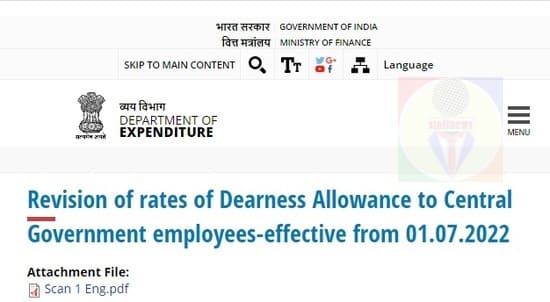
Dearness Allowance – Revised Rates effective from 01.07.2022: DoE OM dated 03.10.2022

 Dearness Allowance – Revised Rates effective from 01.07.2022: DoE OM dated 03.10.2022


No. 1/3/2022-E-II (B)
Government of India
Ministry of Finance
Department of Expenditure

North Block, New Delhi
Dated the 3rd October, 2022.

OFFICE MEMORANDUM

Subject: Revision of rates of Dearness Allowance to Central Government employees- effective from 01.07.2022.

The undersigned is directed to refer to this Ministry’s Office Memorandum No. 1/2/2022-E-II(B) dated 31.03.2022 on the subject mentioned above and to say that the President is pleased to decide that the rate of Dearness Allowance payable to Central Government employees, shall be enhanced from 34% to 38% of the Basic Pay with effect from 1st July, 2022.

2. The term ‘Basic Pay’ in the revised pay structure means the pay drawn in the prescribed Level in the Pay Matrix as per 7th CPC recommendations accepted by the Government, but does not include any other type of pay like special pay, etc.

4. The payment on account of Dearness Allowance involving fractions of 50 paise and above may be rounded to the next higher rupee and the fractions of less than 50 paise may be ignored.

5. These orders shall also apply to the civilian employees paid from the Defence Services Estimates and the expenditure will be chargeable to the relevant head of the Defence Services Estimates. In respect of Armed Forces personnel and Railway employees, separate orders will be issued by the Ministry of Defence and Ministry of Railways, respectively.

6. In so far as the persons serving in the Indian Audit and Accounts Department are concerned, these orders are issued in consultation with the Comptroller and Auditor General of India, as mandated under Article 148(5) of the Constitution of India.

(Nirmala Dev)
Director

To,
All Ministries/Departments of the Government of India (as per standard distribution list)
Copy to: C&AG, UPSC, etc. as per standard endorsement list.


Read More ->>

Personal/private vehicles owned by Government employee.

 Personal/private vehicles owned by Government employee.

File No.T-11014/12/2016-General-l

T-11014/12/2016-General-l Government of India Ministry of Health & Family Welfare Department of Health & Family Welfare

General-l Section

NirmanBhawan, New Delhi, Dated the 30/09/2022

OFFICE MEMORANDUM

Subject: - Personal/private vehicles owned by Government employee.

In terms of Department of Expenditure's OM No. 18(23)/E-Coord.2021 dated

01.09.2022 on the subject mentioned above, private/personal vehicles owned by the Government Employees shall not be permitted to mention "Government of India" on their vehicles.

2. All Officers/staffs of the Ministry may please note the above direction for strict

compliance.

Digitally Signed by K

Venkatesan

Date: 30-09-2022 11:34:27 Reason: Approved

(K Venkatesan)

Under Secretary to the Govt. of India

Read More ->>

Counting of periods spent on training as qualifying service for pension and gratuity under the Central Civil Services (Pension) Rules, 2021: DoP&PW OM No. – 28/90/2022-P&PW(B)/8297 dated 02.10.2022

 Counting of periods spent on training as qualifying service for pension and gratuity under the Central Civil Services (Pension) Rules, 2021: DoP&PW OM No. – 28/90/2022-P&PW(B)/8297 dated 02.10.2022

No. – 28/90/2022-P&PW(B)/8297
Government of India
Ministry of Personnel, Public Grievances and Pensions
Department of Pension and Pensioners’ Welfare

3 Floor, Lok Nayak Bhavan, Khan Market,
New Delhi, Dated the 2nd October, 2022

OFFICE MEMORANDUM

Subject: Counting of periods spent on training as qualifying service for pension and gratuity under the Central Civil Services (Pension) Rules, 2021.

The undersigned is directed to say that Department of Pension and Pensioners’ Welfare has notified the Central Civil Services (Pension) Rules, 2021 in supersession of the Central Civil Service (Pension) Rules, 1972. In accordance with Rule 22 of the Central Civil Services (Pension) Rules, 2021, in the case of a Government servant who was required to undergo a departmental training before regular appointment to a Group C post and was in receipt of pay in a scale of pay or a stipend or a nominal allowance during such training, the period of such training shall count as qualifying service. In other cases, the Government may, by order, decide whether the time spent by a Government servant under training immediately before appointment to service under that Government shall be counted as qualifying service.

2. Where time spent by a Government servant under training immediately before appointment to service under that Government is counted as qualifying service, interruption due to the training and regular appointment being at different stations, not exceeding the joining time permissible under the rules of transfer, is required to be counted as qualifying service. Where the period of interruption is in excess of joining time due to administrative reasons, such period of interruption in excess of joining time is required to be regularised by grant of leave of the kind due or, if no such leave is due, by grant of extraordinary leave by the Head of Department. The period of interruption regularised by grant of extraordinary leave in such cases is required to be counted as qualifying service.

3. All Ministries/Departments are requested that the above provisions regarding counting of period spent on training and period of interruption due to the training and regular appointment being at different stations, as qualifying service for pension and gratuity under the Central Civil Services (Pension) Rules, 2021 may be brought to the notice of the personnel dealing with the pensionary benefits in the Ministry/ Department and attached/ subordinate offices thereunder, for strict implementation.

(S. Chakrabarti)
Under Secretary to the Govt. of India

To
All Ministries/Departments/Organisations
(As per standard list)


Read More ->>

Sunday, 2 October 2022

Indian Railways to release its new All India Railway Time Table known as “Trains At A Glance (TAG)” w.e.f. 1st October, 2022

                                                                       Ministry of Railways

Indian Railways to release its new All India Railway Time Table known as “Trains At A Glance (TAG)” w.e.f. 1st October, 2022

It will be available on Indian Railways’ official website i.e. www.indianrailways.gov.inAs a part of digitalization of train Time Table, Trains at a Glance (TAG) to be available as ‘e-Book’ which can be downloaded from IRCTC website

Posted On: 30 SEP 2022 5:38PM by PIB Delhi

The Ministry of Railways will be releasing its new All India Railway Time Table known as “TRAINS AT A GLANCE (TAG)” effective from 1st October, 2022. The new Trains at a Glance will also be available w.e.f. 1st October, 2022 on Indian Railways’ official website i.e. www.indianrailways.gov.in.

Highlights of the new time table are as follows:

  1. Indian Railways runs about 3,240 Mail/Express trains which include Vande Bharat Express, Gatimaan Express, Rajdhani Express, Shatabdi Express, Humsaafar Express, Tejas Express, Duronto Express, Antyodaya Express, Garib Rath Express, Sampark Kranti Express, Yuva Express, Uday Express, Janshatabdi Express and other types of trains. In addition, about 3,000 Passenger trains and 5,660 suburban trains are also operated over the Indian Railways network. The volume of passengers carried daily is about 2.23 Crore.
  2. To clear extra rush and meet passenger demand, more than 65,000 Special train trips were operated during 2021-22. About 566 coaches were permanently augmented to increase the carrying capacity.
  3. Maximize the utilization of rolling stock:

    1. During review of the lie over of rakes it was observed that the rakes can be better utilized for extending the existing services or increasing the frequency. This would maximize the utilization of the rolling stock and provide better connectivity to the travelling passengers.
    2. During the year 2021-22, 106 new services were introduced, 212 services were extended and frequency of 24 services was increased.
  4. Proliferation of Premium Trains:

    1. At present, Vande Bharat Express trains are operating between New Delhi – Varanasi and New Delhi – Shri Mata Vaishno Devi Katra. One more Vande Bharat Express train has been introduced between Gandhinagar Capital and Mumbai Central w.e.f. 30.09.2022. It has been proposed to introduce more Vande Bharat Express trains over the Indian Railways network.
    2. Tejas Express services offering onboard services like entertainment, local cuisine, wifi etc. are also being proliferated over Indian Railway network. At present, 7 pairs of Tejas Express services are operational over Indian Railways.
  5. Provision of Corridor Blocks in the working Time-Table of the divisions:

    To provide sufficient time for the maintenance of the fixed infrastructure like track structure, signaling gears, overhead equipments, it has been planned to ensure provision of fixed corridor blocks. The duration of these corridors blocks will be from 3 hours in each section. This will not only improve the reliability of the assets but also enhance the passenger safety.

  6. Conversion of Rakes ICF to LHB:

    The conversion of Mail/Express trains operating with ICF design rakes is being undertaken to improve passenger safety and provide faster transit with better riding comfort. Indian Railways converted 187 Rakes of ICF to LHB for the period of 2021-2022.

  7. Efforts to improve punctuality of late running trains:

    Necessary changes in the time table have been incorporated to improve punctuality. Due to concerted efforts the punctuality of Mail/Express trains has improved by about 9% as compared to the punctuality during pre Covid (2019-20).

  8. Standardization of rakes:

    The rakes at different maintenance depots have been standardized by integration of the rake links to improve flexibility in operations and thereby help in improving punctuality.

  9. Replacement of conventional Passenger trains with MEMU/DEMU:

    In the year 2021-22, 60 number of conventional passenger services have been replaced by MEMUs thereby increasing the overall mobility of the system.

  10. Availability of Trains at a Glance as “e-Book”:

    As a part of digitalization of train Time Table, Trains at a Glance (TAG) will now also be available as ‘e-Book’ which can be downloaded from IRCTC website (www.irctc.co.in & www.irctctourism.com).

*****

YB

(Release ID: 1863836)

Read More ->>

Submission of Annual Life Certificate: Department of Pension and Pensioners’ Welfare O.M. dated 30.09.2022

 Submission of Annual Life Certificate: Department of Pension and Pensioners’ Welfare O.M. dated 30.09.2022

No. 1(8)/2021-P&PW(H)-7468
Government of India
Ministry of Personnel, Public Grievances and Pensions
Department of Pension and Pensioners’ Welfare

8th Floor, B-Wing, Janpath Bhawan
Janpath, New Delhi-1 10001
Dated the 30th September, 2022

OFFICE MEMORANDUM

Subject: Submission of Annual Life Certificate

Every Central Government pensioner has to submit Annual Life Certificate in the month of November for further continuation of pension. It has been observed that a large number of Central Government pensioners physically visit bank branches for this purpose.

2. As a measure to enable an additional exclusive window to very senior pensioners, this Department, vide its OM No. 1/20/2018-P&PW(E) dated 18.07.2019, has allowed the pensioners in the age group of 80 years and above, to submit Annual Life Certificate from 1st October onwards, instead of 1st November onwards, every year.

3. The different modes available to a pensioner for submission of Annual Life Certificate are once again summarized for Pensioners’ awareness. An Annual Life Certificate can be submitted manually or digitally as per convenience of the pensioner by following modes: –

  1. Life certificate can be recorded by Pension Disbursing Authorities (PDAs), if the pensioner physically appears before the PDA.
  2. Personal appearance of a pensioner will not be required, if the pensioner submits the life certificate form signed by any ‘designated official’. In accordance with para 14.3 of the Scheme Booklet issued by CPAO, a pensioner who produces a life certificate in the prescribed form, signed by persons specified, is exempted from personal appearance. A list of designated officials specified for signing the Life Certificate as per the scheme booklet of CPAO is attached as Annexure-I.
  3. Pensioners can submit Life Certificate online through Jeevan Pramaan Portal. The process of submission of Digital Life Certificate through “Jeevan Pramaan” may be seen at https://youtu.be/nNMIkTYqTF8. UIDAI has provided details of all biometric devices which are permissible for capturing biometrics of a person. Pensioners may visit the site www.uidal.gov.in to get information of all such devices.
  4. India Post Payments Bank (IPPB) of Department of Posts along with Meity have successfully launched the initiative of the Department of Pension & Pensioners’ Welfare: “Doorstep Service for submission of Digital Life Certificate through Postman” in November 2020. IPPB is utilizing its national network of more than 1,36,000 access points in Post Offices and more than 1,89,000 Postmen & Gramin Dak Sevaks with smart phones and biometric devices to provide Doorstep Banking Services for generation of Digital Life Certificates. For leveraging this facility through a mobile phone, a pensioner has to download “Postinfo APP” from Google Play store. The process of submission of Digital Life Certificate through Postmen/Gramin Dak Sevaks may be seen at https://youtu.be/cERWM_U7g54.
  5. Doorstep Banking is also available through the Alliance comprising 12 Public Sector Banks which do “Doorstep Banking” for its customers in 100 major cities of the country under Ease of Banking reforms. PSB Alliance has introduced the service for collection of Life Certificates under the umbrella of Doorstep Banking. DSB Agent shall visit the doorstep of Pensioner to render the service. Service can be booked by the pensioner through any of the 3 channels 1.e. Mobile App, Website or Toll – Free Number.
    • Mobile App i.e “Doorstep Banking (DSB)” can be downloaded from Google Playstore.
    • Pensioners can access through Web Browser ie https://doorstepbanks.com/&https://dsb.imfast.co.in/doorstep/login
    • Through Toll free Number:- 18001213721,18001037188.
  6. Pensioners can also submit Life Certificates using the Face Authentication technology system bascd on UIDAI Aadhaar software whereby it is possible to generate a Digital Life Certificate from any Android based smart phone by capturing the live photograph of the pensioner for online submission on the Jeevan Pramaan mobile application. The process flow for generating DLCs through Face Authentication is available on DoPPW’’s Pensioners’ Portal > Jeevan Pramaan > Process flow of face authentication technique for DLC generation.
    (https://pensionersportal.gov.in/Document/Face%20Authentication%20Process7/o200f%20Jeevan%o20Pramaan%20App%20.pdf)

4. All Pension Disbursing Authorities are requested to take note of this OM for compliance and give wide publicity of the same amongst pensioners.

5. This issues with the approval of the competent authority.

(Ashok Kumar Singh)
Under Secretary to the Govt. of India
Tel. No. 23310108

Annexure-I

List of persons specified for signing the Life Certificate (para 14.3 of Scheme Booklet by CPAO)

  1. A person exercising the powers of a Magistrate under the Criminal Procedure code;
  2. A Registrar or Sub-Registrar appointed under Indian Registration Act;
  3. A Gazetted officer of the Government;
  4. A Police Officer not below the rank of Sub-Inspector in-charge of a Police Station;
  5. A Postmaster, a departmental Sub-Postmaster or an Inspector of Post Offices;
  6. A Class-I officer of the Reserve Bank of India, an officer (including Grade IJ officer) of the State Bank of India or of its subsidiary;
  7. A Justice of Peace;
  8. A Block Development Officer, Munsif, Tehsildar or Naib Tehsildar:
  9. A Head of Village Panchayat, Gram Panchayat, Gaon Panchayat or an
  10. Executive Committee of a Village;
  11. A Member of Parliament, of State legislatures or of legislatures of Union Territory Governments/Administrations;
  12. Treasury Officer.
Read More ->>