Saturday, 5 March 2022

Regarding splitting of higher denomination Accounts into multiple lower denomination accounts.

 Regarding splitting of higher denomination Accounts into multiple lower denomination accounts.

 Department of Posts : India

O/o The Chief Postmaster General, Odisha Circle

Bhubaneswar-751001


No. SB/52-08/Rev.Target 2017-18 Ch-II        Dated at Bhubaneswar the 04.03.2022


To

All SSPOs/ SPOs Odisha Circle.


Sub: Regarding splitting of higher denomination Accounts into multiple lower denomination accounts.


        It has come to notice that Post Office staff and GDS under instruction from Divisional and Sub Divisional Heads have started opening of low value of POSB Accounts(RD, 1 Yr. TD etc.) in their own or family members name to achieve targets and to show increase in volume of business which is against the spirit and in contravention of instruction issued vide Directorate Letter No.116-26/2015-SB dated 19.08.2015. The Department do not want accounts which will be silent first and get closed later on. The motto of the Department is to increase customer base and financial inclusion of all.


        All Divisional Heads are requested to submit report on number of staff/ GDS opened POSB Accounts in February, 2022 and March, 2022 and amounts deposited therein. By mid March, 2022 APMG(Vig) and AD(SB) will visit Head Post Office to verify these accounts which are a burden to the system and bad business as well.


        It should be born in mind that POSB drive is to have new small savers and their financial inclusion and not merely to achieve targets/ number.


        Therefore, I am directed to refrain from asking our own staff and GDS to open lower denomination multiple accounts in a single scheme in theirs or their family members’ name unless they want.


        All the staff/ GDS in each unit may be sensitized about this. Please remember that we have to achieve monthly target in April also which will benchmark the involvement of staff with the members of public/ customers.       


                                                                                   (Kamalendu Panda)   

Asst. Director (SB/PBI)

 Chief P.M. G.

Odisha Circle, Bhubaneswar-751001

Copy to-


1.      The PMG Berhampur Region/ Sambalpur Region for information and necessary action.


 Asst. Director(SB/FS/PBI)

O/o-the Chief Postmaster General, 
Odisha Circle, Bhubaneswar -751001
Tele : (0674) 2514167/ 9438120248


Read More ->>

Relaxation in the eligibility service-change in the crucial date, i..e. 1st January

 Relaxation in the eligibility service-change in the crucial date, i..e. 1st January


Read More ->>

Friday, 4 March 2022

Amendment in Civil Accounts Manual Revised Second Edition -2007 Volume-I & II regarding Income Tax on Provident Fund

 Amendment in Civil Accounts Manual Revised Second Edition -2007 Volume-I & II regarding Income Tax on Provident Fund

F. No. TA-2-01001/1/2022-TA-CGA (E-9369) /78
Government of India /
Ministry of Finance
Department of Expenditure
Office of Controller General of Accounts
Mahalekha Niyantrak Bhawan,
GPO Complex, E-Block, INA, New Delhi-110023

Dated, the 03rd March, 2022.

Subject: Amendment in Civil Accounts Manual Revised Second Edition -2007 Volume-I & II (Reprinted in 2012)

Correction Slip No. 26

Page No.

CAM reference

Amendments

–

–

The following new para namely 6.1.3 is inserted:

6.1.3 The term “balance” in this Chapter is meant for total of both taxable and non-taxable GPF account of the provident fund account of a subscriber.

123

Para 6.4.2 of CAM-Advance from the fund [Rule 12 of GPF (CS) Rules]

The second sentence in para 6.4.2 begins with “On receipt of sanction in such cases ……… in the ledger folio” is substituted with the following:

On receipt of sanction in such cases, the full particulars of the sanction shall be noted by the PAO in the relevant column of ledger folio in a manner that advance would first be debited against balance available under taxable accumulation and remaining from non-taxable accumulation on the date of payment of advance.

124

PARA-6.5- Withdrawal from the fund [Rule 15 GPF (CS) Rules]


The para 6.5.2 is substituted with the following:

After scrutiny of the sanction as above, they shall be entered in the of relevant column of the ledger folio in such a manner that withdrawal amount would first be adjusted against taxable accumulation and remaining from non-taxable accumulation. Payments against such sanctions will be made only after pre-check of the bill by the P.A.O.

125

Para-6.6.-Transfer of G.P. Fund Account

(1) The second sentence of para 6.6.2 starts with “In such cases, only an extract from the ledger ……….. the following details”, is substituted with the following:

“All the copies of ledger folios/cards shall be appended, duly attested by the Pay and Accounts Officer which will, inter alia, include following details:

(2) In the para 6.6.2 (v) and (vi), the word “three” is deleted.

126

Para-6.7 Maintenance of G.P. Fund Account

In the second sentence of para 6.7.7 starts with “He should take out the schedules ……………… column of the account”, the following text is inserted:

Subscription will be posted first under non-taxable column of ledger folio and be continued to the subsequent months till it reaches the limit of Rs. Five lakhs in a financial year am, subsequently subscription will be posted under taxable column the ledger folio.

Refund of advance will be posted under the relevant column of non­ taxable /taxable column of the ledger folio from which advance have been taken. In case advance constitutes both taxable and no­ taxable amount of the provident account then refund will be post earliest under taxable column of ledger folio till the advance on the taxable column is fully refunded and subsequently non-taxable column will be posted till the last installment of advance is fully recovered.

415-
419

Form CAM-47

Existing Form CAM-47 has been substituted with the new Form CAM-47 (enclosed).

421-
422

Form CAM-49

Existing Form CAM-49 has been substituted with the new Form CAM-49(enclosed).

This issues with the approval of CGA.

(Neelakanian R.)
Senior Accounts Officer


Source: Finmin

Read More ->>

5 Reasons Government Jobs are Important to India

 5 Reasons Government Jobs are Important to India

Government jobs are crucial for India’s growth and development. They have a direct impact on the country’s economy. The government hires people from different backgrounds, which means that it is important for the govt to be more inclusive in its hiring process.

There are many benefits of being a govt employee, like job security and a guaranteed pension. The Indian government has continued to grow in size, with the number of employees increasing from 18.5 million in 2008 to 25.3 million in 2021. The Indian government is one of the largest employers in India, and it is important for India’s growth and development.

The importance of a job within the government cannot be overstated, as they provide services that are essential to the development of society. This includes maintaining public order, enforcing laws and regulations, providing public education and healthcare, as well as facilitating economic growth by building infrastructures such as roads and bridges.

Government jobs are important for India’s growth and development because they provide services that are essential to society’s development such as maintaining public order, enforcing laws and regulations, providing public education and healthcare, building infrastructure like roads and

A government job is a job in the government sector. Government jobs in India are categorized into two broad categories- civil services and defense services.

Civil Services: These are jobs that are related to the administration of the country, such as civil servants, IAS officers, Indian Forest Service officers, and so on.

Defense Services: These are jobs that are related to the defense of the country, such as armed forces personnel, Indian Coast Guard officers, and so on.
Government Jobs in India – Advantages of Joining

The PSC Govt jobs in India are a dream for many. The reason is that these jobs are secure, stable, and well-paying.

India has a long history of being ruled by the British. They left India in 1947 after they lost the Indian Independence Movement. Since then, India has been governed by its own elected representatives who are chosen every five years through democratic elections.

The constitution of India provides for a parliamentary system of government with a bicameral legislature and federal division of powers into three organs: the Parliament, the executive branch led by the Prime Minister and his Council of Ministers, and the judiciary composed of various courts headed by Supreme Court which is the highest court in all disputes arising out of any law enacted by Parliament or any state legislature.

The current state of Indian government employment is a topic that has been discussed for a long time. The number of government jobs in India is uncertain, but it is estimated to be over 3 million.

There are many ways to get a government job in India, but the most common way is through competitive exams like UPSC and SSC.
What are the Disadvantages of Working for the Government?

Working for the government is not always a glamorous job. There are many disadvantages to working for the government. One of these is that you can’t be a part of any other organization or company, which can limit your growth. Another disadvantage is that you have to work in the office for 8 hours every day and there are no weekends off.

Another reason why people might want to stay away from government jobs is that they don’t pay as well as private-sector jobs. However, this could be because they have more benefits than just salary and they also get paid time off when they need it.
Read More ->>

Bharat Pensioners Samaj demands :PARITY in healthcare for all Govt. Pensioners

 Bharat Pensioners Samaj demands :PARITY in healthcare for all Govt. Pensioners


Read More ->>

Thursday, 3 March 2022

Union Cabinet is expected to make DA Announcement any day by next week

 Union Cabinet is expected to make DA Announcement any day by next week

The Cabinet Committee on Economic Affairs headed by Prime Minister shall meet time to time to decide over important economical affairs of our Country. One of such decision to be expected by central government employees from Union cabinet is to make announcement of releasing additional instalment of DA from January and July of every year.

DA announcement before second part of Budget session of Parliament

The first part of the budget session was held from January 31 to February 11 and the second part will take place from March 14 to April 8, 2022. Hence it is expected that Central government may announce DA hike before the start of second part of Budget Session of Parliament.

Union Cabinet Decision over January 2022 DA enhancement

As per the approved formula for calculation of rate of Dearness Allowance, the DA shall be enhanced by 3% from 31% to 34% with effect from 1.1.2022. Hence the Union Cabinet is expected to give its approval for DA enhancement proposal in the month of March as it was done before.

Composition of Cabinet Committee on Economic Affairs

  1. Prime Minister.
  2. Sri Rajnath Singh Minister of Defence.
  3. Sri Amit Shah. Minister of Home Affairs. And Minister of Corporation cooperation.
  4. Sri Nitin Jai ram Gadkari. Minister of Road Transport and highways.
  5. Smt. Nirmala Sitharaman. Minister of Finance and Minister of Corporate Affairs.
  6. Shi. Narendra Singh Tomar. Minister of Agriculture and Farmers Welfare.
  7. Dr Subramanyum Jaishankar. Minister of External Affairs.
  8. Sri Piyush Goyal. Minister of Commerce and Industry. Minister of Consumer Affairs, Food and public distribution and Minister of textiles.
  9. Sri Dharmendra Pradhan. Minister of Education and Minister of Skill Development and Entrepreneurship.

Date of DA announcement made in March by Union Cabinet 

Below is the date on which the January DA hike was announced in previous years

  1. January 2016 DA Announcement on 23.3.2016
  2. January 2017 DA announcement on 15.03.2017
  3. January 2018 DA announcement on 07.3.2018
  4. January 2019 DA announcement on 19.2.20219
  5. January 2020 DA announcement on 13.3.2020
  6. January 2021 DA – Frozen
  7. January 2022 DA announcement : expected at any date in March 2022

DA Table from January 2016 to January 2022

Effect from        

Rate of DA

Effect from        

Rate of DA

01/01/2016

Nil

01/01/2020

17%  +4% (Frozen)

01/07/2016

2%

01/07/2020

17%  +3% (Frozen)

01/01/2017

4%

01/01/2021

17%  +4% (Frozen)

01/07/2017

5%

01/07/2021

31%

01/01/2018

7%

01/01/2022

34%(To be announced)

01/07/2018

9%


01/01/2019

12%


01/07/2019

17%


Read More ->>

Payment of provisional pension and gratuity under Rule 62 of the Central Civil Services (Pension) Rules, 2021 in case of delay in issue of PPO authorizing regular pension

 Payment of provisional pension and gratuity under Rule 62 of the Central Civil Services (Pension) Rules, 2021 in case of delay in issue of PPO authorizing regular pension


Read More ->>

Central Civil Services (Payment of Gratuity under National Pension System) Rules, 2021

 Central Civil Services (Payment of Gratuity under National Pension System) Rules, 2021


Read More ->>

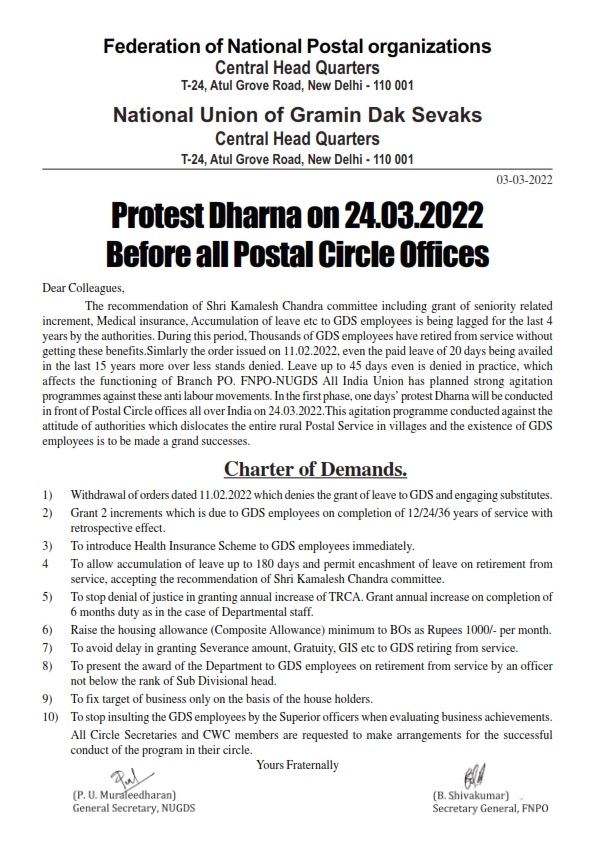
FNPO : Protest Dharna on 24/03/2022

 FNPO : Protest Dharna on 24/03/2022

Read More ->>