Wednesday, 4 December 2019

Pradhan Mantri Laghu Vyapari Maan-dhan Scheme: National Pension Scheme for Traders, Shopkeepers and Self-Employed Persons – Loksabha QA

Pradhan Mantri Laghu Vyapari Maan-dhan Scheme: National Pension Scheme for Traders, Shopkeepers and Self-Employed Persons – Loksabha QA

Press Information Bureau
Government of India
Ministry of Labour & Employment
02-December-2019 15:03 IST
National Pension Scheme for Traders, Shopkeepers and Self-Employed Persons
National Pension Scheme for Traders, Shopkeepers and Self-Employed Persons (originally proposed name was, Pradhan Mantri Laghu Vyapari Maan-dhan Scheme) has been launched on 12.09.2019. It is a voluntary and contributory pension scheme.
Enrolment to the Scheme is done through the Common Service Centres, with its network of 3.50 lakh Centres across the country. In addition eligible persons can also self-enroll through visiting the portal www.maandhan.in.
The traders in the age group of 18-40 years with an annual turnover, not exceeding Rs.1.5 crore and who are not a member of EPFO/ESIC/NPS/PM-SYM or an income tax payer, can join the scheme. Under the scheme, 50% monthly contribution is payable by the beneficiary and equal matching contribution is paid by the Central Government. Subscribers, after attaining the age of 60 years, are eligible for a monthly minimum assured pension of Rs.3,000/-. As the Scheme has been launched on 12th September, 2019. It envisages a coverage of about 50 lakh enrolments under the Scheme for 2019-20. In order to achieve this, various measures including celebration of Pension Week/ Pension Saptah have been taken. All State/UT Governments were requested for popularizing and bringing more awareness about the Scheme. The progress of the Scheme is being reviewed regularly in the Ministry at senior level with State/UT Governments, for taking initiatives under Mission Mode.
This information was given by Shri Santosh Kumar Gangwar Union Minister of State (I/C) for Labour and Employment in written reply to a question in Lok Sabha today.
******
Source: PIB
Read More ->>

Tuesday, 3 December 2019

Notification : Postal Assistant (PA)/ Sorting Assistant (SA): Pay Level-4 (Rs. 25,500-81,100) || SSC CHSL 2019

Notification : Postal Assistant (PA)/ Sorting Assistant (SA): Pay Level-4 (Rs. 25,500-81,100) || SSC CHSL 2019


How to apply:

10.1 Applications must be submitted in online mode only at the official website of SSC Headquarters i.e. https://ssc.nic.in. For detailed instructions, please refer to Annexure-III and Annexure-IV of this Notice.

10.2 Last date for submission of online applications is 10-01-2020 (2400 Hours).

10.3 Candidates are advised in their own interest to submit online applications much before the closing date and not to wait till the last date to avoid the possibility of disconnection/ inability or failure to login to the SSC website on account of heavy load on the website during the closing days.

10.4 The Commission does not accept any responsibility for the candidates not being able to submit their applications within the last date on account of the aforesaid reasons or for any other reason beyond the control of the Commission.

10.5 Before submission of the online application, candidates must check that they have filled correct details in each field of the form. After submission of the online application form, no change/ correction/ modification will be allowed under any circumstances. Requests received in this regard in any form like Post, Fax, Email, by hand, etc shall not be entertained.
Read More ->>

Madras High Court on Tuesday clarified that whose service were regularised before April 1, 2003 shall be entitled for pensionary benefits.

Madras High Court on Tuesday clarified that whose service were regularised before April 1, 2003 shall be entitled for pensionary benefits.

Madras High Court on Tuesday clarified that whose service were regularised before April 1, 2003 shall be entitled for pensionary benefits.

Since two division benches gave conflicting orders as to the eligibility of such employees in getting pension benefits, the chief justice referred the matter to the full bench.

The Madras High Court on Tuesday clarified that persons employed by the state government under non-provincialised service, consolidated pay, honorarium or daily wage basis and whose service were regularised before April 1, 2003 shall be entitled for pensionary benefits.

Half of service rendered by them before regularisation shall be counted for the purpose of conferment of pensionary benefits, a full bench comprising Justice R Subbiah, Justice P T Asha and Justice C Saravanan said.

The issue pertains to pleas moved by such state government employees who were denied pension by the government citing government order dated August 6, 2003 which denied pension to those employees appointed after April 1, 2003.

Since two division benches gave conflicting orders as to the eligibility of such employees in getting pension benefits, the chief justice referred the matter to the full bench.

Pronouncing the order on Tuesday, the full bench also clarified that those employees who were hired on temporary basis and regularised after April 1, 2003 were not eligible for the state government pension scheme.

Since 1980, several persons came to be employed on daily wage basis in various departments of the state.

Those daily wage employees joined the service under the belief that their services will be eventually regularised in future and that they could be inducted into the permanent rolls of the government.

Some were fortunate to get their service regularised before March 1, 2003 while others could not till they attained the normal age of superannuation.

For some others, even though they could get their service regularised, at the time of their regularisation, they had very little left in terms of period of service and therefore, after their retirement, from the cadre post, they could not get pension inasmuch as they did not have the minimum qualifying years of service for the purpose of grant of pension.

Source : 
Read More ->>

Monday, 2 December 2019

Setting up of CGHS Dispensaries/Hospitals – Lok Sabha QA

Setting up of CGHS Dispensaries/Hospitals – Lok Sabha QA

Press Information Bureau
Government of India
Ministry of Health and Family Welfare
29-November-2019 12:47 IST
Setting up of CGHS Dispensaries/Hospitals
The norms for establishment of new Wellness Centre under CGHS are as under:-
I. In an existing CGHS City:-
For opening of a new CGHS Wellness Centre in an existing CGHS City, there has to be a minimum of 2000 Card holders (serving employees of Central Government and Central Civil Pensioners).
II. Extension of CGHS to a new City:-
For extension of CGHS to a new City, there has to be a minimum of 6000 Card holders.
At present, there is no such proposal. Opening of new CGHS Wellness Centre is considered as per the extant norms in this regard, subject to availability of resources.
The Minister of State (Health and Family Welfare), Sh Ashwini Kumar Choubey stated this in a written reply in the Lok Sabha here today.
Source: PIB
Read More ->>

AICPIN for the month of October 2019

AICPIN for the month of October 2019

No. 5/1/2019-CPI
GOVERNMENT OF INDIA
MINISTRY OF LABOUR & EMPLOYMENT
LABOUR BUREAU

`CLEREMONT’, SHIMLA-171004
DATED: 29th November, 2019

Press Release
Consumer Price Index for Industrial Workers (CPI-IW) – October, 2019

The All-India CPI-IW for October, 2019 increased by 3 points and pegged at 325 (three hundred and twenty five). On 1-month percentage change, it increased by (+) 0.93 per cent between September, 2019 and October, 2019 when compared with the increase of (+) 0.33 per cent for the corresponding months of last year.

The maximum upward pressure to the change in current index came from Food group contributing (+) 2.85 percentage points to the total change. At item level, Wheat, Wheat Atta, Goat Meat, Milk Buffalo, Milk Cow, Garlic, Onion, Brinjal, Cabbage, Cauliflower, Gourd, Lady’s Finger, Potato, Tomato, Torai, Cooking Gas, Electricity Charges, Medicine (Homeopathic), College Fee, Petrol, etc. are responsible for the increase in index. However, this increase was checked by Ginger, French Bean, Radish, Apple, Lemon, Orange, Bus Fare, Hair Oil, etc., putting downward pressure on the index.

The year-on-year inflation based on CPI-IW stood’ at 7.62 per cent for October, 2019 as compared to 6.98 per cent for the previous month and 5.23 per cent during the corresponding month of the previous year. Similarly, the Food inflation stood at 8.60 per cent against 7.05 per cent of the previous month and (-) 0.95 per cent during the corresponding month of the previous year.

At centre level Varanasi and Jamshedpur observed the maximum increase of 12 points each followed by Munger-Jamalpur and Chhindwara (11 points each) and Jabalpur (9 points). Among others, 8 points increase was observed in 2 centres, 7 points in 4 centres, 6 points in 4 centres, 5 points in 12 centres, 4 points in 6 centres, 3 points in 15 centres, 2 points in 11 centres and 1 point in 10 centres. On the contrary, Goa recorded a maximum decrease of 4 points followed by Tiruchirapally, Ajmer and Delhi (2 points each). Rest of the 5 centres’ indices remained stationary.

The indices of 32 centres are above All-India Index and 44 centres’ indices are below national average. The indices of Ernakulam and Warrangal centres remained at par with All-India Index.

The next issue of CPI-IW for the month of November, 2019 will be released on Tuesday, 31st December, 2019. The same will also be available on the office website www.labourbureaunew.gov.in.
Read More ->>

डाक विभाग के खिलाफ 25 लाख शिकायतें, लोग इनसे हैं सबसे ज्यादा परेशान

डाक विभाग के खिलाफ 25 लाख शिकायतें, लोग इनसे हैं सबसे ज्यादा परेशान

सरकार भले ही डाक विभाग के कामकाज के तौर-तरीकों और तकनीक को बदलने पर पूरा जोर लगा रही हो, लेकिन ग्राहकों की शिकायतें कम होने का नाम नहीं ले रही हैं। संसद में पूछे गए एक सवाल के जवाब में सरकार की तरफ से बताया गया है डाकियों के खिलाफ सालाना 11 से 12 हजार शिकायतें आ जाती हैं। वहीं, पूरे डाक विभाग की बात करें तो यह आंकड़ा 23 से 25 लाख सालाना है।

सरकार ने यह भी माना है कि शहरी और ग्रामीण दोनों क्षेत्रों के ग्राहकों की तरफ से ज्यादातर शिकायतें समय पर डाक न मिलने की होती हैं। केंद्रीय मंत्री रविशंकर प्रसाद ने संसद में दिए जवाब में यह भी बताया है कि डाक सेवाओं से जुड़ी शिकायतों के समाधान के लिए टोलफ्री हेल्पलाइन शुरू की जा चुकी है। वाराणसी और पटना में इस बाबत कॉल सेंटर बनाए गए हैं। प्रसाद ने यूपीए कार्यकाल के आखिरी वर्षों की मौजूदा सरकार के पहले दौर के कार्यकाल से तुलना भी की।

Read More ->>

Investors India - Postal Savings Scheme - Nov 2019

Investors India - Postal Savings Scheme - Nov 2019


Read More ->>

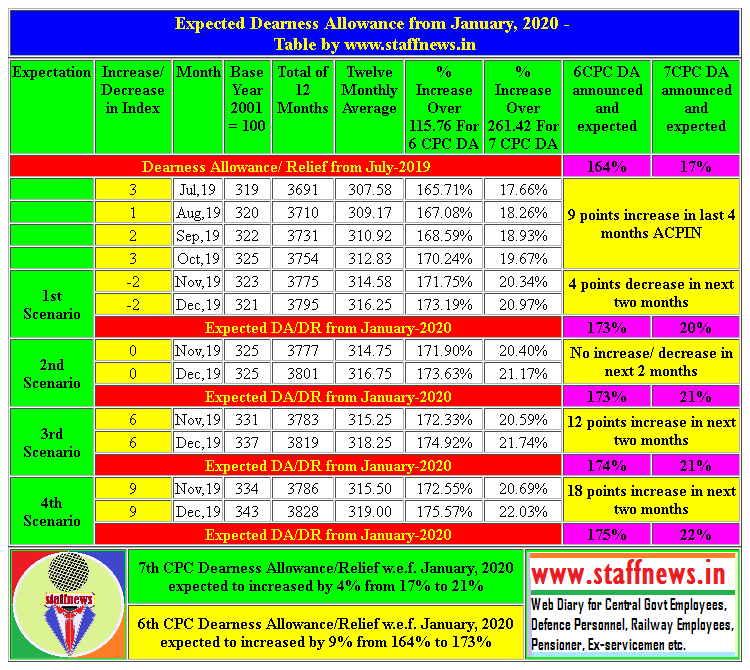
DA/DR from January, 2020 – Expected to increase 4% from 17% to 21% and 9% increase in 6th CPC DA

DA/DR from January, 2020 – Expected to increase 4% from 17% to 21% and 9% increase in 6th CPC DA

DA/DR from January, 2020 – Expected to increase 4% from 17% to 21% and 9% increase in 6th CPC DA

All India Consumer Price (Industrial Workers) Index Number [CPI(IW)] for October, 2019 has released by Labour Bureau. CPI-IW for October, 2019 increased by 3 points and pegged at 325 (three hundred twenty five). And with this increase in AICPIN the Central Govt. Employees and Pensioners are expected to get 4% increase in Dearness Allowance/Relief with effect from January, 2020 in 7th CPC Pay structure thus the existing rate of 17% expected to be 21% from January, 2020. On the other hand employees who are drawing their pay in pre-revised 6th CPC pay structure will get 9% increase in Dearness Allowance w.e.f. January, 2020 at the rate of 173%, which is currently 164%.

Detail calculation of DA from January, 2020 to be 21% in 7th CPC & 173% in 6th CPC pay structure with AICPIN of October-2019 is furnished in undermentioned table. Following 4 scenarios are illustrated in the calculation table:-
1st Scenario – Minimum 4 points cumulative decrease from November & December, 2019 ACPIN will decrease the expectation of January, 2020 DA/DR to 20%.
2nd Scenario – Expectation in no change in November & December, 2019 ACPIN is confirming January, 2020 DA/DR to be 21%
3rd Scenario – From a minimum 12 points cumulative increase from November & December, 2019 ACPIN the expectation of 6th CPC January, 2020 DA is increasing to 174%
4th Scenario – A minimum 18 points cumulative increase from November & December, 2019 ACPIN will required to increase the expectation of DA/DR from January, 2020 from 21% to 22%
expected-da-from-january-2020-table-by-staffnews
Read More ->>

The Industrial Relations Code Bill, 2019 Introduced in Lok Sabha today

The Industrial Relations Code Bill, 2019 Introduced in Lok Sabha today

Ministry of Labour & Employment

The Industrial Relations Code Bill, 2019 Introduced in Lok Sabha today

Posted On: 28 NOV 2019 3:32PM by PIB Delhi
The Minister of State (I/C) for Labour and Employment Shri Santosh Kumar Gangwar introduced The Industrial Relations Code Bill, 2019 in the Lok Sabha today. While introducing the Bill Shri Gangwar said that the Code has been prepared after wide consultations with Trade union representatives, Employer’s organizations and State Governments.
The Bill aims to consolidate and amend the laws relating to trade unions, conditions of employment in industrial establishment or undertaking, investigation and settlement of industrial disputes.
The draft code on Industrial Relations has been prepared after amalgamating, simplifying and rationalizing the relevant provisions of following three Central Labour Acts viz: The Trade Unions Act, 1926, The Industrial Employment (Standing Orders) Act, 1946 and The Industrial Disputes Act, 1947.
The Union Cabinet approved the Industrial Relations Code, 2019 on November 20, 2019.
Benefits:
Setting up of two-member tribunal (in place of one member) introducing a concept that some of the important cases will be adjudicated jointly and the rest by a single member resulting speedier disposal of cases.
To impart flexibility to the exit provisions (relating to retrenchment etc.), for which, the threshold for prior approval of appropriate Government has been kept unchanged at 100 employees, but added a provision for changing ‘such number of employees’ through notification.
The re-skilling fund is to be utilised for crediting to workers in the manner to be prescribed.
Definition of Fixed Term Employment and that it would not lead to any notice period and payment of compensation on retrenchment excluded.
Vesting of powers with the government officers for adjudication of disputes involving penalty as fines thereby lessening the burden on tribunal.
Read More ->>