Directorate called views/comments on the recommendations submitted by cadre restructuring committee from GS
Dear Arup
The Committee constituted for Cadre restructuring of Inspector of Posts (IPs)/Asst. Superintendent of Post offices (ASPOs) in the Department of Posts has submitted its Draft Report. A copy of Recommendations of the Committee is attached herewith.
In this regard, it is requested to kindly furnish your views/comments on said recommendations at the earliest. The Views/Comments may kindly be furnished before 11.00 AM on 10th February 2019. In case no comments are received, it will be presu umed that you have no comments to offer.
Thanks
With kind regards
Establishment Division
Department of Posts
Dak Bhavan, New Delhi.
Recommendations of the Committee
1. Upgradation of all Class II Divisions (headed by PS Gr. B Officer) to Class I (headed by JTS cadre) –
At present, there are 189 Class I Divisions (168 Postal and 21 RMS) in the Department and 348 Class II Divisions (298 Postal and 50 RMS)-(Table-1). This differentiation is very artificial as in terms of duties, powers, targets, responsibilities, there is no difference between Class I and Class II Divisions. The only difference, generally found, is the size of the Division. In the Departmental volumes also, with reference to duty chart of these two Divisional Heads, no differentiation is made. If the artificial differentiation between these two kinds of Divisions is abolished by upgrading all Class II Divisions to the status of Class I that will be commensurate to the responsibilities that the Divisional heads perform. Also this up-gradation will create more promotional opportunities to the feeder cadres i.e. Inspector Posts and Assistant Superintendents Posts and in consequence there will be reduction in the waiting period for promotion, from about 25 years to about 15 years. This may perhaps create equality in promotional opportunities as in the case of time lines prevailing in other Departments like In-come Tax, Customs, Central Excise etc. This upgradation is likely to mitigate the frustration prevailing amongst IP/ASP cadres and the cadres can be motivated for better performance. The Committee, therefore, strongly and unanimously recommends upgradation of all Class II Postal and RMS Divisions to the status of Class I.
2. Since sudden enhancement in the number of JTS strength may upset the structure of I.Po.S (Gr ‘A’) cadre, it is recommended that vacancies arising due to upgradation of 348 posts in JTS will be filled up only on promotion from the feeder grade specified in the relevant recruitment Rule. After five years, vacancies arising in JTS Grade will be filled up as per DOPT guidelines and RRs i.e. 50% from DR and 50% from DP. Such kind of privilege was extended by Government to the similarly placed cadres in Customs Department (Para 4 of the Ministry of Finance, Department of Revenue, Central Board of Excise & Customs letter no. A.11019/08/2013-Ad.IV dated December 18, 2013 refers)(Copy enclosed). Therefore, the same kind of freedom may be extended to the IP/ASP cadres of this Department also for getting real benefit of this recommendation.
3. Based on the recommendations of 7th CPC, PS Group B cadre who heads Class II Divisions, is placed at Level_______ equivalent to Grade Pay of Rs.5,400/- (6th CPC) whereas JTS Class I officers who heads Class I Divisions also carry Grade Pay of Rs.5,400/- (6th CPC), who are also placed___________________. Therefore, there is no additional financial implication involved in this recommendation. It was found that out of 348 posts proposed to be upgraded to JTS, 339 are manned by such officers who are already drawing same scale under MACP-III.
4. Upgradation of one ASP post to PS Group B Cadre in every Divisional Office
– At present, in every Divisional Office, at least one ASP post is available. In view of the recommendation made above vide para 10 for upgrading all Class II Postal and RMS Divisions to the status of Class I, it would be appropriate to upgrade one ASP post, available in the Divisional Office, to the cadre of PS Group B. This upgradation is also recommended in view of increased responsibility of the Divisions to the changing scenario. Moreover, JTS Class I officer who heads the Division needs to be assisted by an experienced and reasonably higher cadre officer like PS Group B. However, it was recommended by the Committee that in such Postal / RMS Divisions where already a PS Gr. ‘B’ post is there (in the form of Dy. SP / SRM Sorting etc.) no further post of ASP will be upgraded. Instead we will redeploy upgraded post of ASP in the following:
Ø Superintendent, Foreign Post, where all Sub-Foreign Posts have been ordered to be upgraded
Ø Manager (BD) to take care of BD work in Circle Headquarter
5. At present most of the RMS Sub Divisions are headed by Inspector of Posts and some by ASP cadre. The Committee is of the view that there is no full justification for the continuance of these Sub Divisions due to inadequate workload. It is, therefore, recommended that merger of some RMS Sub Divisions are needed and the posts thus rendered redundant may be redeployed to the needy Circles and in Postal Directorate where at present ASPs are called and are attached. This exercise may be carried out by the Heads of Circles to identify surplus posts so that those can be posted either in Regional Offices, Circle Office, Postal Directorate or any other needy office. Therefore, the Committee recommends merging some RMS Sub Divisions. No financial implications are involved in this proposal.
6. It is often noticed that many Inspector cadre officers are posted in their initial stage of service at Circle Offices, Regional Offices and Postal Directorate. In such cases those Inspectors do not acquire required field experience and remain professionally handicapped all along. Appropriate experience in field is pre-requisite of performing duties effectively in Administrative offices. In the interest of service, therefore, it is essential that a newly recruited / promoted Inspector works in the Sub Divisions during the initial stage of their career. The Sub Divisions are manned today either by IP or by ASP. This differentiation is absolutely mechanical as the duties and responsibilities of Sub-Divisional Heads are same everywhere. There is no financial implications in this proposal Manning of the Sub-divisions by the Inspectors, therefore, has following advantages:
Ø If the Inspector cadre officers are mandated to work in the Sub Division in the initial phase of their career, they will gain requisite field experience to work effectively subsequently in the Administrative offices. This will be good for the cadre as well as for the Department.
Ø We need to have some demarcation between the roles and responsibilities of IP and ASP cadres. Therefore, the Committee strongly and unanimously recommends that all Sub Divisions should be manned by the Inspector cadre officers and other posts in the Administrative offices like Postal Directorate, Circle Office, Regional Office, Divisional Office etc should be manned by ASP cadre officers.
7. Recommendation relating to up gradation of all posts of In-charge, CPC to PS Group B Cadre:
Implementation of Core Banking Solution (CBS) is part of the IT Modernization Project of the India Post, which aims to bring in various IT solutions with the required IT infrastructure to the Post Offices. India Post has implemented a new core banking system across 23,638 Post Offices and installed 994 ATMs replacing the manual paper-based account processing methods. With this, India Post is operating the largest branch network in the entire world, with 150,000 branches. CIRCLE PROCESSING CENTRE (CPC) is set up to provide back end support to the CBS migrated Post Offices working in Finacle software. Circle Processing Centre will be an independent unit under the administrative control of the Circle Office. At present 23 CPCs re functioning in the Department. The working hours of CPC starts from 8.30 hrs to 22.30 hrs (may work round the clock based on the Finacle accessibility) and the establishment of CPC is as under:
(a) In-charge(IP or ASP Cadre)
(b) User Champions (System Administrators)
(c) End Users (Postal Assistants)
(d) MTS
The details of work undertaken by the In-charge, CPCs are as under:
Ø ATM related issues i.e. monitoring the cash loading in ATM machines and respective Transaction entered in the Finacle, ATM down sites, ATM transactions, ATM card issue status, ATM transaction status, ATM audits, taking up the ATM reversal entries with the National ATM unit (NAU, Bangalore), monitoring ATM Physical and ledger balances in the Circle with the POs and the National ATM unit.
Ø Monitoring the user-id reset requests, SOL/Role change requests, Agent user-id reset requests, creation of new user id requests, Operational issues being faced by the Post Offices in Finacle, raising the tickets, monitoring and closing the tickets which are raised after solution.
Ø Generation of reports in respect of SB Schemes for the day in respect of all the migrated POs daily.
Ø Monitoring the blocking validations and teller cash position of all the CBS migrated POs, guiding all the POs in doing EOD, monitoring of execution of EOD first step second step of all the CBS migrated POs at CPC level. Also monitoring EOD third and fourth steps with CEPT Chennai (EOD support team).
Ø In addition to the above work, In-charge, CPCshas tomonitor the migration process and guide the Post Office System Administrators for uploading the data and the same has to be processed and send the data to DMCC, Chennai which need to be monitored till the Office migrates.
Ø To check the KYC forms received from Post Offices as per the prescribed norms and return the KYC forms to concern POs which are not as per the norms.
Ø To monitor the digitization (scanning and cropping) of KYC forms received from all the CBS POs.
Ø To upload the digitized the KYC forms to Finacle.
Ø To monitor non-receipt of all KYC application forms daily from all the migrated POs and correspond with the concerned POs for submission of KYC forms.
Further CPC is allotted with the monitoring and settlement of AMLCFT alerts, which is very sensitive. More than 50 AMLCFT alerts are being received daily, genuineness of every alert has to be confirmed by the concerned Post Office and the same has to be updated/ closed in AMLCFT website.
Types of alerts which are to be checked are as under:
Ø Activity in an Inactive Account (silent account)
Ø Cash withdrawal within 30 days exceeding CTR threshold limit
Ø Huge Cash Deposits in a account
Ø Heavy transactions in multiple accounts of a depositor
Ø Huge Cash Withdrawal in account.
Ø As all the above work is very sensitive in nature and needs to be monitored with the responsible Officer having enough knowledge and experience, the Committee strongly and unanimously recommends upgrading all the 23 CPC posts of IP/ASP to the cadre of PS Group B.
8. Up gradation of all posts at National Speed Post Hub to PS Group B cadre, if not already in that cadre.
National Speed Post Hub deals with receipt and dispatch of Speed Post bags/articles and booking of BNPL Speed Post articles and its dispatch to various Post offices in the country for delivery to the customers. The establishment of the NSH is generally as under:
Ø In-charge
Ø User Champions (System Administrators)
Ø End Users (HSA/Sorting Assistants)
Ø MTSs
The details of work attended to be monitored by the In-charge, NSH are as under:
Ø Consulting and arranging meetings withMajor customers and to enroll them as BNPL (Book Now Pay Later) Speed Post customers. To effect this, make BNPLSpeed Post credit/advance agreements with State/Central GovernmentOrganisations/Nationalised Banks/PSUs/Private firms etc., in coordination with Divisional office/Regional Office.
Ø Providing Pickup service to the BNPL customers.
Ø Maintenance of Bank guarantees of private BNPL credit Speed Post customers.
Ø Renewal of BNPL agreements in due time.
Ø Generation of monthly bills of BNPL customers and send these bills to the customers and ensure to see that payment received in due time.
Ø Visits of BNPL customers for early clearance of outstanding dues.
Ø Verification of daily log sheets of field agents including auto drivers who pick up Speed Post articles from Customers premises.
Ø Submission of monthly Business Performance Report of NSH to Divisional Office/Regional Office.
Ø Monitoring of day and night sets of NSH where receipt of Speed Post bags from various Post offices, opening of bags and dispatch of articles to the destination Post offices without any delay.
Ø Monitoring of BNPL sets for smooth operations.
Ø Arrangement of staff to the sets for smooth operations and also attending staff related matters.
Ø Monitoring of preparation and sanction of eligible incentive bills to the Field Agents.
Ø Ensuring the maintenance of all work papers.
Ø Monitoring of Inward/Outward complaints related to NSH.
Ø Search bills and its follow up.
Ø Monitoring of PG Portal cases.
Ø Proper monitoring of the computer related infrastructure, UPS, Generators pertaining to NSH.
Ø All court cases/RTI related issues.
Ø Attending BNPL correspondence of Divisional office, Regional office and BNPL customers.
Ø Monitoring Routing/MMS schedules/ Due Mail List/Mail arrangements.
NSHs are revenue generation units of the Department. As all the above work are sensitive in nature and needs to be monitored with the responsible officer having enough knowledge and experience. The Committee, therefore, recommends upgrading all in-charge posts of NSH to the PS Group B cadre.
9. Recommendation for creation of leave/ deputation reserve:
Generally, leave reserve and deputation reserve are available in every cadre. In Department of Posts leave reserve is available in clerical cadre (Postal Assistants and Sorting Assistants) as well as in Group ‘A’ level. No leave reserve is available in IP/ASP and in PS Group B cadres. However, depending on the exigencies and requirement, deputations are allowed in these cadres also as in the case of Group A. Leave can not to be refused on the ground of non availability of leave reserves. More than 10% to 12% posts are always vacant resulting heavy burden on the existing staff. Filling up of vacancies also take considerable time as 33.33% of the vacancies are are required to be to be filled up through Staff Selection Commission (SSC) and the Commission normally takes more than two years to complete the process of recruitment and sending the dossiers to the Department. Similarly, departmental examination for DP quota i.e., 66.66% is held once in a year. Therefore, at any point of time in IP/ASP cadre and also in PS Gr. ‘B’ 35% posts remain vacant. It is high time to create leave/ deputation reserve in these three (3) cadres. The Committee, therefore, unanimously and strongly recommends creation of 10% posts in IP, ASP and PS Group B cadres. The Committee also recommends enhancement of leave reserve of 10% in the proposed newly created posts in JTS posts.


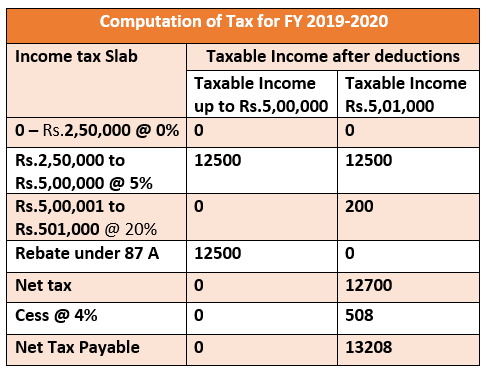 From the above example, we came to know that if one’s Taxable Income is up to Rs.5,00,000, he gets full rebate under 87 A and need not to pay any Tax. Whereas one’s Taxable Income is Rs.5,01,000, he cannot claim rebate under Section 87 A and he has to pay Rs.13208 as Income Tax for earning Rs.1000 income above of Rs.5 Lakh.Is that Correct..? To extend this benefit to the all Tax paying Salaried class , either this rebate under 87 A should be given to all without restricting it to below Rs.5 Lakh or Income Tax Slab may be changed accordingly to make Nil Tax for Income from 2.5 lakh to 5 lakh.


 →


