Read More ->>
Wednesday, 1 August 2018
Tuesday, 31 July 2018
Implementation of Supreme Court order on Reservation in Promotion
Ministry of Personnel, Public Grievances & Pensions
Implementation of Reservation in Promotion for Employees
The Supreme Court in Special Leave Petition (Civil) No.30621/2011 has passed the following order on 17.5.2018:-
“It is directed that the pendency of this Special Leave Petition shall not stand in the way of Union of India taking steps for the purpose of promotion from ‘reserved to reserved’ and ‘unreserved to unreserved’ and also in the matter of promotion on merits..”.
Further, in the matter related to Special Leave Petition (Civil) No.31288/2017 connected to Special Leave to Appeal (Civil) No.28306/2017, the Supreme Court held as under on 05.06.2018:-
“Heard learned counsel for the parties, Learned ASG has referred to order dated 17.05.2018 in SLP(C) No.30621/2011. It is made clear that the Union of India is not debarred from making promotions in accordance with law, subject to further orders, pending further consideration of the matter. Tag to SLP (C) No.30621 of 2011.”
Based on interim Orders/directions of the Supreme Court dated 17.05.2018 and 05.6.2018, Department of Personnel and Training vide Office Memorandum No. 36012/11/2016- Estt.(Res-I) {Pt-II} dated 15.06.2018 requested all the Ministries/Departments of the Government of India to carry out promotions in accordance with above directions of the Supreme Court on existing seniority / select lists subject to further orders which may be passed by the Supreme Court. The State Governments were advised to take necessary action in accordance with the above-mentioned orders passed by the Supreme Court.
This information was provided by the Union Minister of State (Independent Charge) Development of North-Eastern Region (DoNER), MoS PMO, Personnel, Public Grievances & Pensions, Atomic Energy and Space, Dr Jitendra Singh in written reply to a question in Rajya Sabha today
Read More ->>
Retirement Benefits after Implement
Retirement Benefits after Implementation of 7th CPC Recommendation
After the Implementation of 7th CPC recommendation the retirement benefits of Central Government Employees are updated . Gratuity ceiling increased to 20 Lakhs and other benefits like Pension, Commutation of Pension, Encashment of EL, GPF Balance and CGEGIS Benefits are paid as per Revised Pay Rules. The details about the Retirement Benefits of CG Staffs are given below
Pension
The minimum eligibility period for receipt of pension is 10 years. A Central Government servant retiring in accordance with the Pension Rules is entitled to receive pension on completion of at least 10 years of qualifying service.
In the case of Family Pension the widow is eligible to receive family pension on death of her spouse after completion of one year of continuous service or even before completion of one year if the Government servant had been examined by the appropriate Medical Authority and declared fit for Government service.
W.e.f 1.1.2006, Pension is calculated with reference to emoluments (i.e.last basic pay) or average emoluments (i.e. average of the basic pay drawn during the last 10 months of the service) whichever is more beneficial. The amount of pension is 50% of the emoluments or average emoluments whichever is beneficial.
Minimum pension presently is Rs. 9000 per month. Maximum limit on pension is 50% of the highest pay in the Government of India (presently Rs. 1,25,000) per month. Pension is payable up to and including the date of death.
Commutation of Pension
A Central Government servant has an option to commute a portion of pension, not exceeding 40% of it, into a lump sum payment. No medical examination is required if the option is exercised within one year of retirement. If the option is exercised after expiry of one year, he/she will have to under-go medical examination by the specified competent authority.
Lump sum payable is calculated with reference to the Commutation Table. The monthly pension will stand reduced by the portion commuted and the commuted portion will be restored on the expiry of 15 years from the date of receipt of the commuted value of pension. Dearness Relief, however, will continue to be calculated on the basis of the original pension (i.e. without reduction of commuted portion).
The formula for arriving for commuted value of Pension (CVP) is
CVP = 40 % (X) Commutation factor* (X)12
* The commutation factor will be with reference to age next birthday on the date on which commutation becomes absolute as per the New Table annexed to the CCS (Commutation of Pension) Rules, 1981.
Death/Retirement Gratuity
Retirement Gratuity
This is payable to the retiring Government servant. A minimum of 5 years’ qualifying service and eligibility to receive service gratuity/pension is essential to get this one time lump sum benefit. Retirement gratuity is calculated @ 1/4th of a months Basic Pay plus Dearness Allowance drawn on the date of retirement for each completed six monthly period of qualifying service. There is no minimum limit for the amount of gratuity. The retirement gratuity payable for qualifying service of 33 years or more is 16 times the Basic Pay plus DA, subject to a maximum of Rs. 20 lakhs.
Death Gratuity
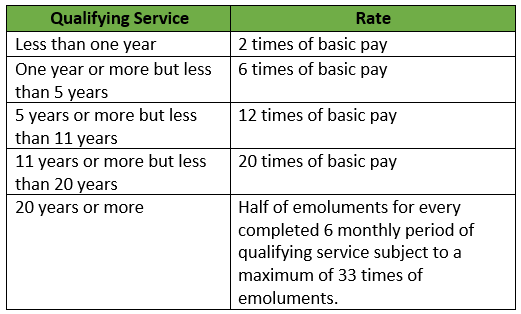
This is a one-time lump sum benefit payable to the nominee or family member of a Government servant dying in harness. There is no stipulation in regard to any minimum length of service rendered by the deceased employee. Entitlement of death gratuity is regulated as under:
Qualifying Service Rate
Maximum amount of Death Gratuity admissible is Rs. 20 lakhs w.e.f. 1.1.2016
Service Gratuity
A retiring Government servant will be entitled to receive service gratuity (and not pension) if total qualifying service is less than 10 years. Admissible amount is half months basic pay last drawn plus DA for each completed 6 monthly period of qualifying service. This one time lump sum payment is distinct from retirement gratuity and is paid over and above the retirement gratuity.
Issue of No Demand Certificate
Dues owed by the retiring employees on account of Licence Fee for Government accommodation, advances, over payment of pay and allowances are required to be assessed by the Head of Office and intimated to the Accounts Officer two months in advance of the date of retirement so that these are recovered from retirement gratuity before payment. For this purpose the Licence Fee for those in occupation of Government accommodation is taken into account up to the end of the permissible period for which accommodation can be retained after retirement under the Rules on normal rent. The recovery of Licence Fee beyond that period is the responsibility of the Directorate of Estates. If, for any reason final dues cannot be assessed on time, then 10% of gratuity is withheld from gratuity on the basis of a commutation from the Directorate of Estates in this regard.
General Provident Fund and Incentives
As per General Provident fund (Central Services) Rules, 1960 all temporary Government servants after a continuous service of one year, all re-employed pensioners (Other than those eligible for admission to the Contributory Provident Fund) and all permanent Government servants are eligible to subscribe to the Fund. However, these rules are not applicable to any of the Government Servants who join service on or after 1.1.2004. A subscriber, at the time of joining the fund is required to make a nomination, in the prescribed form, conferring on one or more persons the right to receive the amount that may stand to his credit in the fund in the event of his death, before that amount has become payable or having become payable has not been paid. A subscriber shall subscribe monthly to the Fund except during the period when he is under suspension. Subscriptions to the Provident Fund are stopped 3 months prior to the date of superannuation. Rates of subscription shall not be less than 6% of subscribers emoluments are not more than his emoluments. Rate of interest varies according to notifications of the Government issued from time to time. The rules provide for drawal advances/ withdrawals from the fund for specific purposes.
The conditions for withdrawal from the fund have been liberalized and now no documentary proof is required to be furnished by the subscriber for GPF withdrawal. On retirement of a subscriber, instructions have been issued for immediate payment of final balance on retirement. No application is required to be submitted by the subscriber for final payment from the fund. .
Deposit Linked Insurance Scheme
Under the GPF Rules, on the death of subscriber, the person entitled to receive the amount standing to the credit of the subscriber shall be paid an additional amount equal to the average balance in the account during the 3 years immediately preceding the death of the subscriber subject to certain conditions provided in the relevant Rule. The additional amount payable under that Rule shall not exceed Rs. 60,000/-. To get this benefit, the subscriber should have put in at least 5 years service at the time of his/her death.
Contributory Provident Fund
The Contributory Provident Fund Rules (India), ,1962 are applicable to every non-pensionable servant of the Government belonging to any of the services under the control of the President. A subscriber, at the time of joining the Fund is required to make a nomination in the prescribed Form conferring on one or more persons the right to receive the amount that may stand to his credit in the Fund in the event of his death, before that amount has become payable or having become payable has not been paid.
A subscriber shall subscribe monthly to the Fund when on duty or Foreign Service but not during the period of suspension. Rates of subscription shall not be less than 10% of the emoluments and not more than his emoluments. The employer’s contribution at that percentage prescribed by the Government will be credited to the subscriber’s account and this is 10%. The Rules provide for drawal of advances/ withdrawals from the CPF for specific purposes. As in GPF Rules, the CPF Rules also provide for Deposit Linked Insurance Scheme.
Leave Encashment
Encashment of leave is a benefit granted under the CCS (Leave) Rules and is not a pensionary benefit. Encashment of Earned Leave/Half Pay Leave standing at the credit of the retiring Government servant is admissible on the date of retirement subject to a maximum of 300 days.
Central Government Employees Group Insurance Scheme
A portion of monthly contributions paid while in service is credited in a Saving Fund, on which interest accrues. A Government servant while entering service has to apply in Form No. 4 of the above Scheme to the Head of Office, who shall issue a sanction for the payment of subscriber’s accumulation in the Savings Fund segment together with interest and arrange for its disbursement, soon after retirement. Payments under this Scheme are made in accordance with the Table of Benefit (as issued by Department of Expenditure) which takes in to account interest up to the date of cessation of service. Insurance cover benefit under this Scheme is available to the family in the event of death of the subscriber.
Source : Pensioner Portal
Read More ->>
Level in Pay Matrix replaces existing Grade Pay and Pay Band in Service Rules
F.No. AB-14017/13/2016-Estt.(RR) (Part-I)
Government of India Ministry of Personnel,
Public Grievances and Pensions Department of Personnel and Training
Estt.-RR Division
North Block, New Delhi
Dated: 25th July 2018
OFFICE MEMORANDUM
Sub: Seventh Central Pay Commission’s recommendations-revision of pay scales amendment of Service Rules/ Recruitment Rules.
The undersigned is directed to refer to this Department’s OM of even number dated 9th August, 2016 regarding amendment of Service Rules/Recruitment Rules by replacing the existing Pay Band and Grade Pay with the corresponding Level in the Pay Matrix in the revised pay structure recommended by the Seventh CPC and notified in the CCS (Revised Pay) Rules, 2016.
2. In the light of above all cadre controlling authorities of Organized Group A services are hereby requested to amend the SRs as per DOPT OM dated 30.08.2016 to conformity with 7th CPC pay structure. The information in this regard may also be furnished to the undersigned latest by 31st July 2018 in the format enclosed
Encl.: As above
(Shukdeo Sah
Under Secretary to Government of India
Read More ->>
June 2018 AICPIN Released – DA 2% Hike Confirmed
According to Labour Bureau press release the AICPIN for June 2018 increased 2 Points and 2% DA Hike Confirmed from 1st July 2018
No. 5/1/2018-CPI
GOVERNMENT OF INDIA
MINISTRY OF LABOUR & EMPLOYMENT
LABOUR BUREAU
CLEREMONT’, SHIMLA-171004
DATED: 31st July, 2018
Press Release
Consumer Price Index for Industrial Workers (CPI-1W) — June, 2018
The All-India CPI-1W for June, 2018 increased by 2 points and pegged at 291 (two hundred and ninety one). On 1-month percentage change, it increased by (+) 0.69 per cent between May, 2018 and June, 2018 when compared with the increase of (+) 0.72 per cent between the corresponding months of previous year.
The maximum upward pressure to the change in current index came from Food group contributing (+) 1.86 percentage points to the total change. At item level, Rice, Fish Fresh, Eggs (Hen), Onion, Brinjal, Cabbage, Cauliflower, French Bean, Gourd, Potato, Tomato, Sugar, Electricity Charges, Doctor’s Fee. Medicine (Allopathic), Sercondary School Fee, Petrol, etc. are responsible for the increase in index. However, this increase was checked by Groundnut Oil, Banana, Coconut, Lemon, Mango (Ripe), Parval, Primary School Fee, etc., putting downward pressure on the index.
The year-on-year inflation based on CPI-IW stood at 3.93 per cent for June, 2018 as compared to 3.96 per cent for the previous month and 1.08 per cent during the corresponding month of the previous year. Similarly, the Food inflation stood at 0.97 per cent against 1.66 per cent of the previous month and (-) 1.28 per cent during the corresponding month of the previous year.
At centre level Quilon reported the maximum increase of 10 points followed by Jharia (7 points) and Rourkela (6 points). Among others, 5 points increase was observed in 4 centres, 4 points in 10 centres, 3 points in 12 centres, 2 points in 16 centres and 1 point in 18 centres. On the contrary, Darjeeling recorded a maximum decrease of 2 points followed by Hyderabad with 1 point. Rest of the 13 centres’ indices remained stationary.
The indices of 37 centres are above All-India Index and 39 centres’ indices are below national average. The indices of Jalandhar and Jabalpur centres remained at par with All-India Index.
The next issue of CPI-IW for the month of July, 2018 will be released on Friday, 31st August, 2018. The same will also be available on the office website www.labourbureaunew.gov.in.
(AMRIFLAL JANGID)
DEPUTY DIRECTOR
Read More ->>
ATM Transaction Charges
GOVERNMENT OF INDIA
MINISTRY OF FINANCE
LOK SABHA
MINISTRY OF FINANCE
LOK SABHA
UNSTARRED QUESTION NO: 1677
ANSWERED ON: 27.07.2018
ATM Transaction Charges
1677. SHRI CHANDRAKANT KHAIRE:
Will the Minister of FINANCE be pleased to state:-
(a) whether the Government proposes to increase ATM transaction charges;
(b) If so, the details thereof and the reasons therefor;
(c) the total number of ATM Cards distributed so far by Public Sector Banks across the country; and
(d) the total number of functional ATMs in the country, State/UT-wise?
ANSWER
The Minister of State in the Ministry of Finance(SHRI SHIV PRATAP SHUKLA)
(a) and (b) As per Reserve Bank of India’s (RBI’s) direction on ‘Usage of ATMs – Rationalization of number of free transactions’, dated 14.08.2014, the details of free/charged ATM transactions are as follows:
(i) a minimum of five free ATM transactions at a bank’s own ATM at any location is permitted during a month.
(ii) a minimum of three free transactions at any other bank’s ATMs at six metro location, viz. Mumbai, New Delhi, Chennai, Kolkata, Bengaluru and Hyderabad is permitted during a month.
(iii) a minimum of five free transactions at any other bank’s ATM at non-metro location is permitted during a month.
(iv) Beyond this minimum number of free ATM transactions, banks have their Board approved policy on charges from customers on ATM transactions, subject to a cap on customers’ charges of Rs. 20/- per transaction.
(c) As per the information provided by RBI, the number of outstanding Credit Cards and Debit Cards issued by Public Sector Banks as on 31.5.2018 are 0.83 crore and 72.62 crore respectively.
(d) As informed by the RBI, detail of state/UT-wise deployment of ATMs as on 31.3.2018 is enclosed as per Annexure I.
Read More ->>
Reservation For Scheduled Castes
Press Information Bureau
Government of India
Ministry of Social Justice & Empowerment
Government of India
Ministry of Social Justice & Empowerment
31-July-2018
Reservation for Scheduled Castes
The Constitution of India provides proportionate representation to Scheduled Castes in House of People, Legislative Assemblies of the States, Panchayats and Municipalities. Reservation in admission to educational institutions and services under the State is also available to Scheduled Castes under the Constitution. The Supreme Court has held that reservation in educational institutions and services under the State for Scheduled Castes, Scheduled Tribes and Other Backward Classes should not ordinarily exceed 50%.
This information was given by Minister of State for Social Justice and Empowerment Shri Vijay Sampla in a written reply in Lok Sabha today.
Source: PIB
Read More ->>


→