Tuesday, 2 January 2018

Introduction of Complaint Tracker in Postinfo Mobile App of India Post & issue of revised Citizens’ Charter

Introduction of Complaint Tracker in Postinfo Mobile App of India Post & issue of revised Citizens’ Charter

Ministry of Communications

INTRODUCTION OF COMPLAINT TRACKER IN POSTINFO MOBILE APP OF INDIA POST & ISSUE OF REVISED CITIZENS’ CHARTER

Posted On: 02 JAN 2018 4:10PM by PIB Delhi


With 1.5 lakh Post Offices, the Department of Posts has the most widely distributed postal network in the world. India Post had launched a Postinfo Mobile App on 11.05.2015, which is updated from time to time. Postinfo – the Citizens’ centric android Mobile application of Department of Posts was developed by the Centre for Excellence in Postal Technology. This app has a number of features like tracking consignments, Post Office search, postage calculator, insurance premium calculator and interest calculator. This App of India Post can be downloaded in Android and Windows mobile phones. Five lakh customers have already downloaded the Postinfo App.

The feature of tracking of complaints registered by the customers online on Computerised Customer Care Centres has been introduced in the Postinfo App of India Post last month. This aims at facilitating the complainants to track their complaints on their mobile phones.

In addition to the above, the Department of Posts has reviewed and revised its Citizens’ Charter in December 2017, which is a tool for facilitating the delivery of services to citizens with specified standards, quality and time frame etc. with commitment from the organisation to its customers. The short version of the Citizens’ Charter is displayed in the post offices and the detailed version is available on the website of the Department of Posts i.e. www.indiapost.gov.in.

<><><><><>
SNC
Read More ->>

Financial Resolution and Deposit Insurance (FRDI) Bill, 2017

Financial Resolution and Deposit Insurance (FRDI) Bill, 2017


 Ministry of Finance

Financial Resolution and Deposit Insurance (FRDI) Bill, 2017 seeks to protect and enhance the depositors’ existing rights and bring in a comprehensive and efficient resolution regime for financial firms.


Posted On: 02 JAN 2018 4:07PM by PIB Delhi

Rationale for the Financial Resolution and Deposit Insurance Bill, 2017

There is no comprehensive and integrated legal framework for resolution, including liquidation, of financial firms in India presently.

·                     The powers and responsibilities for resolution of financial services providers are given under multiple laws to regulators, Government and the Courts, which does not facilitate development of specialised resolution capabilities. Also, because of this dispersed role definition, resolution of financial conglomerates becomes difficult. 
·                     The resolution instruments presently available under the respective legislations are limited, and so is guidance on the process leading up to the resolution. For example, the Reserve Bank of India (RBI) is empowered to take certain resolution actions with respect to banks, branches of foreign banks in India, and cooperative banks. However, these resolution powers are quite limited. RBI can effect change in bank management, or impose moratorium and recommend mandatory mergers. In the case of a bank, typically either of the two methods of resolution has been used, that is, amalgamation or merger of a weak bank with another bank; or winding up of the bank. Other resolution instruments are not available. 
·                     The Central Government has the power to restructure public sector banks, and regional rural banks. Non-banking financial companies can be liquidated or wound up under law by High Courts only, either voluntarily or on the application of RBI. Resolution regimes for insurance companies, financial market infrastructure, and other financial services providers are also quite inadequate. The current resolution regime is especially inappropriate for private sector financial firms in the light of significant expansion of private financial firms and many of these acquiring systemically important status in India. The Insolvency and Bankruptcy Code, 2016 has introduced in the country a comprehensive resolution regime for mainly non-financial firms, but such a regime is not available in the country for financial firms.   
The Financial Resolution and Deposit Insurance Bill, 2017 (FRDI Bill) will replace the existing resolution regime by providing a comprehensive resolution regime that will help ensure that, in the rare event of failure of a financial service provider, there is a system of quick, orderly and efficient resolution in favour of depositors. 
·                     The impact of failures of financial services providers is much wider and can have a systemic effect on the economy and financial stability of a country, unlike traditional insolvency, where the affected parties are mostly limited to the creditors of the insolvent entity. Since financial service providers handle consumer funds, some of them are critical for financial stability, and therefore, it is important to resolve failing financial service providers expeditiously through a specialised resolution process, as lengthy resolution proceedings can lead to losses for consumers, or instability in the financial system.
·                     The FRDI Bill proposes to  establish a Resolution Corporation and a comprehensive resolution regime to enable timely and orderly resolution of a failing financial firm. Such institutional framework for expeditious resolution of financial firms exists in most other comparable countries. Further, it is favourable for depositors if in case of bank failures, a bank is resolved rather than liquidated, because the depositors are expected to get a much higher value in resolution of the bank as a going concern than in liquidation.
·                     It provides for detecting incipient insolvencies in financial firms by introducing a five-stage health classification of financial firms and stepping in to appropriately nurse a financial firm at the stage when its health becomes weak and it is classified in the category of material risk to viability, much before it is it is classified in the category of critical risk to viability when there might be no option but to resolve or liquidate the financial firm.  
·                     FRDI Bill also introduces a menu of resolution tools, including transfer of whole or parts of the assets and liabilities of a financial firm to another person, acquisition, merger or amalgamation, bridge service provider, and bail-in, and mandates recovery and resolution planning obligations to enable careful monitoring of risk to viability of a financial firm.
·                     The FRDI Bill also transfers the deposit insurance functions from the Deposit Insurance and Credit Guarantee Corporation to the Resolution Corporation, targeting at an integrated approach to the depositor protection and resolution. 
Protection and enhancement of depositors’ rights under the FRDI Bill 
The FRDI Bill does not modify present protections to the depositors adversely at all. The FRDI Bill provides only additional protections to the depositors in a more transparent manner, the details of which are as follows.

·                     At present, deposits with banks are insured upto Rs. 1 lakh. The similar protection would continue under the FRDI Bill and the Resolution Corporation is empowered to increase the deposit insurance amount.
·                     The uninsured depositors, that is, beyond Rs. 1 lakh, of a banking company are treated on par with unsecured creditors under the present law and paid after preferential dues, including Government dues, in the event of its liquidation. As per the provisions of the FRDI Bill, the claims of uninsured depositors in the case of liquidation of a bank will be higher than those of the unsecured creditors and Government dues. Therefore, the rights of uninsured depositors will be better protected and such depositors will have an elevated status in the FRDI Bill compared to the existing legal arrangements.
·                     Thus, the interests of depositors (both insured and uninsured) would be better protected under the FRDI Bill. 
Bail-in provision 
Indian Banks have adequate capital and are also under prudent regulation and supervision to ensure safety and soundness, as well as systemic stability. The existing laws ensure the integrity, security and safety of the banking system. In India, all possible steps and policy measures are taken to prevent the failure of banks and protection of interests of depositors (e.g. issue of directions  / prompt corrective action measures, capital adequacy and prudential norms). 
Bail in has been proposed as one of the resolution tools in the event a financial firm is sought to be sustained by resolution. Certain misgivings have been expressed in the media, especially social media, regarding the depositor protection in the context of “bail-in” provisions of the FRDI Bill. These misgivings are entirely misplaced. The Government always stands ready to take care of the capital needs of the public sector banks. Bail-in amounts to liabilities’ holders bearing a part of the cost of resolution by reduction in their claims. Bail-in is only one of many resolution tools in the FRDI Bill; others are acquisition, merger and bridge service provider, and is to be used either singly or in combination with other tools. Bail in provision may not be required to be used in case of any specific resolution. Most certainly, it will not be used in case of a public sector bank as such a contingency is not likely to arise. 
Following formal safeguards have been built in the FRDI Bill pertaining to the appropriate use of bail-in, whereas the rights or interests of depositors can be, inter-alia, reduced in case of forced merger of a banking company with another bank under the present law without these explicit safeguards. 
·                     Insured deposits of banks can not be used in case of bail-in.
·                     The Resolution Corporation will have the option to design an appropriate bail-in instrument, which will be subject to Government scrutiny and oversight of the Parliament.
·                     Cancellation of the liability of the depositor beyond insured amount will be possible only with the prior consent of the depositor. On the other hand, in case of the forced mergers of banks under the Banking Regulation Act, 1949, the right of depositors of a merging bank (transferor bank) can be reduced and has been reduced, without the consent of depositors.
·                     Bail-in power can be used in a judicious and reasonable manner only by the Resolution Corporation and it will have to ensure that all creditors, including uninsured depositors, get at least such value, which they would have received in the event of liquidation of a bank. In case of injudicious and unreasonable exercise of bail-in power by the Resolution Corporation, for example, where the depositors of a bank get less value than in liquidation, such affected depositors will have the right to get compensation from the Resolution Corporation on an order of the National Company Law Tribunal. 
The FRDI Bill does not prohibit the Government from extending support to banks 
The FRDI Bill does not propose in any way to limit the scope of powers for the Government to extend financing and resolution support to banks, including public sector banks. Government’s implicit guarantee for solvency of public sector banks remains unaffected as the Government remains committed to adequately capitalise the public sector banks and improve their financial health. The Government is committed to protecting the existing protection to depositors and providing additional protection to them. 
Examination of the FRDI Bill by the Joint Committee of Parliament on FRDI Bill 
The FRDI Bill, introduced in the Lok Sabha on August 10, 2017, is presently under the consideration of the Joint Committee of the Parliament, which is consulting all the stakeholders on the provisions of the FRDI Bill. The Joint Committee of Parliament has been asked to submit their Report to the Parliament by the last day of the Budget Session, 2018. The Government is awaiting the recommendations of the Joint Committee of Parliament in regard to the FRDI Bill and would favourably consider the recommendations.
*****
DSM/SBS/KA

Read More ->>

GPF Interest Rate from January 2018 to March 2018

GPF Interest Rate from January 2018 to March 2018


(PUBLISHED IN PART I SECTION 1 OF GAZETTE OF INDIA)
F.NO. 5(1)-B(PD)/2017
Government of India
Ministry of Finance
Department of Economic Affairs
(Budget Division)
New Delhi, the 1st January, 2018
RESOLUTION
 
       It is announced for general information that during the year 2017-2018, accumulations at the credit of subscribers to the General Provident Fund and other similar funds shall carry interest at the rate of 7.6% (Seven point six per cent) w.e.f. 1st January, 2018 to 31st March, 2018. This rate will be in force w.e.f.1st January, 2018 . The funds concerned are:-
 
1. The General Provident Fund (Central Services).
2. The Contributory Provident Fund (India).
3. The All India Services Provident Fund.
4. The State Railway Provident Fund.
5. The General Provident Fund (Defence Services).
6. The Indian Ordnance Department Provident Fund.
7. The Indian Ordnance Factories Workmen’s Provident Fund.
8. The Indian Naval Dockyard Workmen’s Provident Fund.
9. The Defence Services Officers Provident Fund.
10. The Armed Forces Personnel Provident Fund.
2. Ordered that the Resolution be published in Gazette of India.
(Anjana Vashishtha)
Deputy Secretary (Budget)
Signed Copy is reproduced below

Read More ->>

Smt.Renuka Chowdhary Hon'ble MP Rajya Sabha met Sri.Manoj Sinha ji Hon'ble Minister of Communications & IT on Gramin Dak Sevaks issues

Smt.Renuka Chowdhary Hon'ble MP Rajya Sabha met Sri.Manoj Sinha ji Hon'ble Minister of Communications & IT on Gramin Dak Sevaks issues

Smt.Renuka Chowdhary Hon'ble MP Rajya Sabha met Sri.Manoj Sinha ji Hon'ble Minister of Communications & IT on Gramin Dak Sevaks issues.
Today(02.01.2018 ) Smt.Renuka Chowdhary Hon'ble Member of Parliament ( Rajya Sabha ) met Sri.Manoj Sinha ji Hon'ble Minister of Communications & IT and submitted a Memorandum for requesting immediate implementation of GDS Pay Committee Report and permit the GDS to work more than 5 hours which was given by NUGDS Telangana Delegation on 07.12.2017 consists of Sri.I.Vasantha Rao, Sri.Ch.Koteswara Rao,Sri.M.Nageswara Rao, Sri.V.Srinivasa Rao, Smt.M.Vijaya,Sri.NLN Rao.
Hon'ble Minister assured for early approval of Committee report.
Read More ->>

IPPB Branches Rollout Tracker Status as on 30.12.2017

IPPB Branches Rollout Tracker Status as on 30.12.2017


IPPB Branches Rollout Tracker Status as on 30.12.2017


Read More ->>

A century ago, India got its rare, and strange, Rs 2.5 note

A century ago, India got its rare, and strange, Rs 2.5 note

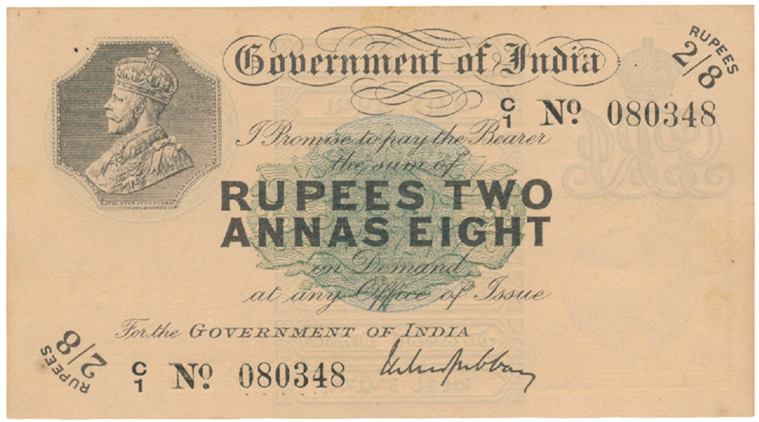
On January 2, 1918, the British government of India released an exotic bank note of Rupees Two and Annas Eight, or two and a half rupees.

rupees two annas eight

While silver coins of a smaller denomination (the silver 1/2 Rupee, 1/4 Rupee and 2 annas) were discontinued and replaced with cupro-nickel coins, the British India government also issued Rupee 1 notes in November 1917 and shortly after that, Rupee 2 ½ notes on January 2, 1918.

On January 2, 1918, the British government of India released an exotic bank note of Rupees Two and Annas Eight, or two and a half rupees, as one rupee in British India was divided into 16 annas — a term adopted from the pre-British Muslim monetary system. This unique, fractional Rupee currency issue completes a centennial today.
According to bank notes enthusiast Dr Suraj Karan Rathi the currency was printed in England on white, handmade paper and bore the emblem of Emperor George V and the signature of erstwhile British finance secretary M M S Gubbay. The currency marked by seven prefix code variations denoting its circle — A (Cawnpore/Kanpur), B (Bombay), C (Calcutta), K (Karachi), L (Lahore), M (Madras) and R (Rangoon) — which was a vestige of earlier years when currency notes used to be legally encashable only within their circle areas. The value of the currency (‘adhai rupya’) was stated at the back in eight Indian languages. Significantly, the value of Rs 2.5 was the exact equivalent $1 at the time.
During World War I years (1914-1918), the prices of silver soared as demand for the metal in the war time grew. So much so that the intrinsic value of the silver rupees, which is the value of the silver in the coin, was perceived as greater than the actual value of the coin. People indulged in speculation and began hoarding coins for their own gains, leading to a shortage of silver for minting sufficient coins for meeting public demand.
Panic of World War I
In one of the first acts of aggression in World War I, when the German warship SMS Emden came to the Madras shore and opened fire at storage tanks of the British-owned Burmah Oil Company on September 22, 1914, the act generated a panic among Indians who lost faith in government issued currency notes. Paper money, at the time, was treated more pragmatically like a legal tender to be encashed for silver coin Rupees by India’s low income classes.
To obviate distrust, the government treasuries were at first forced to cash the paper money for silver coin rupees, but soon reached a point where convertibility was no longer feasible due to insufficient silver reserves. Seeking the help of the government of the United States, the British Indian government was able to replenish silver from the bullions purchased from the US — created out of melted silver dollars. As the late numismatist P L Gupta explained in his seminal volume Indian Paper Money, that year mints in India produced over 260 million silver rupees. And yet they were unable to meet public demand. It became impossible for the government to keep issuing silver coins and imperative for them to conserve and economise the use of the metal.
As a result, the process of withdrawing silver coins from circulation began. While the silver coins of a smaller denomination (the silver 1/2 Rupee, 1/4 Rupee and 2 annas) were discontinued and replaced with cupro-nickel coins, the British India government also issued Rupee 1 notes in November 1917 and shortly after that, Rupee 2 ½ notes. Before this, Rs 5 were the lowest currency notes in circulation.
Referred to in official communication as rupees 2/8, the reason for this odd denomination was noted in Letter No. 139 of 1917 of Government of India’s Finance Department: “We cannot look for immediate acceptance of such notes in any large quantities, and we consider that 2/8 note, which would introduce a fresh denomination intermediate between the available one Rupee coin and a Five Rupees note which ordinarily hold out better chance of success” (As recorded in Kishore Jhunjhunwala and Rezwan Razack’s Reversed Standard Reference Guide to Indian Paper Money). In the beginning, Gupta writes, the currency notes did not evoke trust among the people, and were used in the market only at a discount of 15 – 19 per cent. They were only accepted at par after about a year or two passed since they were introduced into circulation.
Short-lived denomination
A collector’s rare delight, a surviving currency issue of 2 ½ denomination was auctioned for a hammer price Rs 6,40,000 against an estimated Rs 2,50,000-3,00,000 in Mumbai’s Todywalla auctions on December 2, 2015. “It was printed when India was experimenting with shifting from the rupee-anna denomination to the dollar. So they came out with this one, which is equivalent to one dollar. In the public space it did not work, so circulation had to be withdrawn, which is why the note is very rare indeed,” Farokh Todywalla, the founder of Todywalla auctions, told The Hindu.
The currency notes of both Re 1 and Rs 2 ½ were withdrawn from circulation on January 1, 1926 due to cost-benefit considerations, as the Government of India once more reverted to coins — not wholly silver this time. While One Rupee currency notes returned in 1940 (during World War II), another currency note of fractional denomination like 2 ½ was never issued
Read More ->>

Annual Report on Pay & Allowances for 2016-17 - Finance Ministry

Annual Report on Pay & Allowances for 2016-17 - Finance Ministry

Annual Report on Pay & Allowances for 2016-17 - Finance Ministry

Pay Research Unit
Department of Expenditure
Ministry of Finance
New Delhi

ANNUAL REPORT ON PAY & ALLOWANCES FOR THE YEAR 2016-17

SALIENT FEATURES
1. The total expenditure on Pay and Allowances (excluding Productivity Linked Bonus/Ad-hoc Bonus, Honorarium, Encashment of Earned Leave and Travelling Allowance) for Regular Central Government Civilian employees including employees of the Union Territories was Rs.182513.25 crore in 2016-17 as compared to Rs.150028.57 crore in 2015-16. Thus, there is an increase in expenditure by Rs.32484.68 crore over previous year which in relative terms works out to around 21.65%.

2. The Total expenditure on pay and allowances as a percentage of Revenue Receipts and Revenue Expenditure of the Central Government during the financial year 2016-17 is 10.88% and 9.18% as compared 10.45% and 8.43% respectively during the financial year 2015-16.

3. Out of the total expenditure of Rs.182513.25 crore, the percentage expenditure on Pay, Dearness Allowance (DA), House Rent Allowance (HRA) and other allowances are 65.75%, 16.57%, 3.42% and 14.26% respectively.

4. Out of the total expenditure of Rs.6253.93 crore on HRA in 2016-17, the HRA expenditure for ‘X’ class cities is Rs.2817.83 crore which is around 45.06% of the total expenditure on HRA.

5. Almost 86% of the total expenditure was incurred by five major Ministries/ Departments (Railways, Defence(Civil), Home Affairs, Posts and Revenue) during 2016-17.

6. Of the total expenditure on Pay and Allowances in 2016-17, the Ministry of Railways continues to have the largest share i.e 38.92% , marginally increased from 34.98% in 2015-16. Share of Ministry of Home Affairs has decreased from 26.59% to 25.06% and department of Posts has been decreased from 7.74% to 5.55% . Share of Ministry of Defence (Civil) has decreased from the previous year i.e. from 12.11% to 12.04%.

7. The expenditure of UT administrations is Rs.3781.92 crore in 2016-17 as compared to Rs.3382.19 crore in 2015-16. Thus, there is an increase in expenditure by Rs.399.73. crore over previous year which in relative terms works out to around 11.82%.

8. The expenditure of Indian Missions/ Embassies abroad is Rs.1426.08 crore in 2016-17 as compared to Rs.1159.54 crore in 2015-16. Thus, there is an increase in expenditure by Rs.266.54 crore over previous year which in relative terms works out to around 22.98%.

9. As on 01.03.2016, the total number of Regular Central Government Civilian Employees in position was 32.21 lakh against the sanctioned strength of 36.34 lakh and approximately 11.36% of the posts were vacant.

10. Almost 92% of the total manpower is covered by five major Ministries/Departments viz, Railways, Defence(Civil) , Home Affairs, Posts and Revenue. Of the total strength of 32.21 lakh, the percentage share of the Railways is 41.33%, Home Affairs 29.44%, Defence (Civil) 12.37%, Posts 6.02 %, Revenue 3.11% and all other Ministries/ Departments 7.73%

11. Against the sanctioned strength of 9.57 lakh in Central Police Forces, 9.01 lakh employees were in position as on 01.03.2016. In Union Territories (UTs) 64910 employees were in position as on 01.03.2016.

12. DA based on All India Consumer Price Index.


Authority: http://www.doe.gov.in/
Read More ->>

Grant of Special Casual Leave for the purpose of blood donation - DoPT

Grant of Special Casual Leave for the purpose of blood donation - DoPT

No.13020/1/2017-Estt(L)
Government of India
Ministry of Personnel, Public Grievances and Pensions
Department of Personnel & Trining

Old JNU Campus, New Delhi 110 067
Dated: 29.12.2017

Office Memorandum

Subject: Grant of Special Casual Leave for the purpose of blood donation - reg.

The undersinged is directed to refer to the provisions of this Department's O.M. dated 8.10.1956, which provides for grant of Special Casual Leave to a Government servant who donates blood on that day.

2. In this regard, it is noted that presently this rule applies only to whole blood donation and does not cover apheresis donation. It is felt that the rule should cover apheresis donation as well since it will have the added advantage of getting blood components like platelets, plasma etc.

3. In view of the above, it has now been decided that Special Casual Leave may be granted for blood donation or for apheresis (blood components such as cells, plasma, platelets etc.,)donation at licensed Blood Banks on a working day (for that day only) up to a maximum of 4 times in a year on submission of valid prood of donation.

sd/-
(Sandeep Saxena)
Under Secretary to the Government of India

Read More ->>

7th Pay Commission – After HRA Changes, Here Is What Salary Impact Would Be

7th Pay Commission – After HRA Changes, Here Is What Salary Impact Would Be

The 7th Pay Commission report is having an impact on inflation. The other reasons for this impact on inflation expected to go up are the rising oil prices, GST effect etc.

The 7th Pay Commission report is having an impact on inflation. The other reasons for this impact on inflation expected to go up are the rising oil prices, GST effect etc.
The other reason about the role of the commission is that the housing rent allowance has been adjusted upward by the Union Government. In the previous monetary policy review that was held in October, the RBI had projected the inflation to be in the range of 4.2%-4.6% for October-March (second half) period of this fiscal.
The RBI said, “On the whole, inflation is estimated in the range 4.3%- 4.7% in third quarter and fourth quarter of this year, including the HRA effect of up to 35 basis points (0.35%), with risks evenly balanced.”
HRA Increase
HRA increases by various state governments may push up housing inflation further in 2018. The staggered impact of HRA increases by various state governments may push up housing inflation further in 2018. The recent rise in international crude oil prices may sustain, especially on account of the OPEC’s decision to maintain production cuts through next year, the RBI further said.
Inflation climbed up
A report in the Finance Express said that in November, inflation climbed up even breaching the Reserve Bank of India (RBI) of 4% target. Firming crude oil prices in the global market is likely to cast its shadow on retail inflation, which has begun to move northwards after hitting a low of 1.46% in June, and may prompt the RBI to hold interest rates in 2018, the report also said.
Additional burden
The government on the other hand said implementation of new pay scales recommended by the 7th Pay Commission is estimated to put an additional burden of Rs 1.02 lakh cr, or 0.7 per cent of GDP, on the exchequer in 2016-17.
DA has no impact on 7th Pay Commission
The Rajya Sabha was informed that the implementation of the 7th Pay Commission report however, would be after approval of the Cabinet on completion of screening of suggestions by a high-level panel of secretaries.
In a written reply, Minister of State for Finance Jayant Sinha also said that the announcement of Dearness Allowance has no impact on the recommendations of the Pay Commission. He further said that the burden on pay head would increase by Rs 39,100 crore to about Rs 2.83 lakh crore in the current fiscal. Without the 7th Pay Commission recommendations, the outgo would have been Rs 2.44 lakh crore, he also said.
Source: FE
Read More ->>