Monday, 30 October 2017

Finacle : Closing of RD Account if loan exists.

Finacle : Closing of RD Account if loan exists.

Closing of RD Account if loan exists.

Premature Closure ( If 60 months not elapsed from date of opening)

Invoke the RD Closure menu CRDCAAC from Operator Login. System will automatically deduct the RD Loan amount and interest will be calculated on SB Rate of interest as per rule. Loan interest will not be calculated. RD Loan account balance will become 0 but will not be closed. Loan account with Zero balance should be remained as it is and not closed. No need to invoke HLAUPAY or HPAYOFF for repaying the Loan amount.

On Maturity ( If 60 months elapsed from date of opening)

RD Loan amount should be adjusted before closing the RD account. Invoke the menu HPAYOFF (Loan Pay Off Process) to pay the pending principal along with interest. Interest will be calculated at the prescribed rate. Total amount displayed to be collected from the customer. In case of transfer, select the repayment account of customer or office account from where the loan amount is adjusted. Supervisor need to verify the same. Invoke the menu HCAAC to close the RD Loan account and verify the same. Invoke the menu CRDAAC to close the RD Account.
Read More ->>

Celebrate World thrift day (30 Oct 2017) Open Postal Savings Account is providing Banking to Everyone....

Celebrate World thrift day (30 Oct 2017) Open Postal Savings Account is providing Banking to Everyone....

Celebrate World thrift day (30 Oct 2017) Open Postal Savings Account is providing Banking to Everyone....


Read More ->>

Mandatory installation of LED based lighting in all Government buildings

Mandatory installation of LED based lighting in all Government buildings


Mandatory installation of LED based lighting in all Government buildings


Most Immediate
No.25(24)/E.Coord/2017
Government of India
Ministry of Finance
Department of Expenditure
North Block, New Delhi
Dated the 30th October, 2017
OFFICE MEMORANDUM

Subject: Economy Measures- Mandatory installation of LED based lightings in Government Buildings- reg.

Reference is invited to this Department's OM of even number dated 04.08.2017 on the subject mentioned above and to inform that the implementation progress was reviewed recently by Group of officers vide meeting in Cabinet Secretariat on 29.09.2017.

2. As per decision taken during the deliberation, all Ministries/Departments are requested to ensure that replacement work of old bulbs with new LED based lightnings is completed by 31.10.2017 in your offices including Attached/Subordinate Offices, CPSUs, Autonomous Bodies and field offices.

3. It is requested that Ministries/Departments should apprised Department of Expenditure with the action taken in this regard by 10.11.2017 positively as per the format attached.

4. Further, each Ministry/Department should nominate a Nodal Officer at the level of Joint Secretary for monitoring the progress and certifying completion of installation of LED based lightings and energy efficiency measures on behalf of the Ministry/Department. The names of the nominated officers should be provided by 03.11.2017.
(H. Atheli)
Director
To,
All Secretaries of Ministries/Departments

Source: DoE
Read More ->>

India Post issued a set of 2 commemorative postage stamps on "India Russia-Joint Issue" of denomination Rs 5 & Rs 25 on 26.10.2017

India Post issued a set of 2 commemorative postage stamps on "India Russia-Joint Issue" of denomination Rs 5 & Rs 25 on 26.10.2017


Read More ->>

Non uploading the encrypted file through HTTUME Menu

Non uploading the encrypted file through HTTUME Menu

Click below link to download revised Schedule exe for Generating error free Pay uploading file.
Dear SAs
A new exe is attached herewith to overcome the existing issue. Please cut and keep old exe somewhere safe and replace the new exe and generate the encrypted Pension file and try to upload through finacle

Thanks to  P.Silambarasan for sharing content

You may also visit: | 
Read More ->>

PFRDA takes a new initiative to increase pension coverage by increasing the incentives payable to Points of Presence (POPs)

PFRDA takes a new initiative to increase pension coverage by increasing the incentives payable to Points of Presence (POPs)

Press Information Bureau
Government of India
Ministry of Finance
27-October, 2017
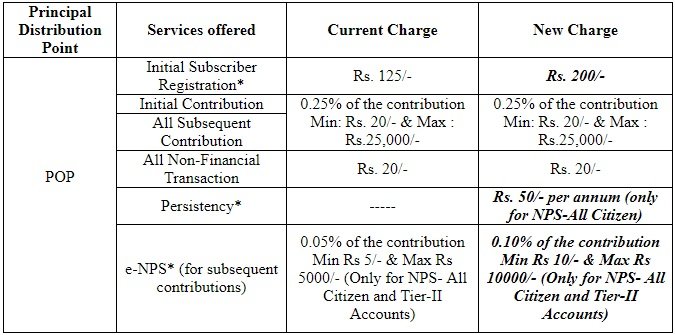
PFRDA takes a new initiative to increase pension coverage by increasing the incentives payable to Points of Presence (POPs), the principal distributive points for NPS.
Pension Fund Regulatory and Development Authority (PFRDA) has taken several initiatives in the past few years to increase pension coverage in the country, notably introducing e-NPS, reducing minimum contribution levels, new investment instruments, aggressive life cycle funds etc.
PFRDA has now taken a further step in this direction by increasing the incentives payable to Points of Presence (POPs), the principal distributive points for National Pension System (NPS).
The following Table gives the details of increase in incentives:
*Changes effected
A new incentive towards increasing persistency has been introduced under which POPs will receive an incentive of Rs. 50/- per account per annum for every account which continues to contribute a minimum of Rs 1000/- in a financial year.
PFRDA believes that the renewed incentive will help in increasing the reach of pensions in India, through the efforts of Points of presence (POPs).
Source:PIB
Read More ->>

Delhi Chalo

Read More ->>

Easing GST pain for SMEs: More rate cuts, hike in composition scheme cut-off likely on 10 Nov

Easing GST pain for SMEs: More rate cuts, hike in composition scheme cut-off likely on 10 Nov

The ministerial panel working to make Goods and Services Tax (GST) composition scheme more attractive today suggested slashing tax rate to 1 percent for manufacturers and restaurants, while making norms for traders opting for the scheme easier.
Currently, manufacturers and restaurants with turnover up to Rs 1 crore pay GST under composition scheme at 2 percent and 5 percent respectively. The same for traders is 1 percent.
The Group of Ministers (GoM), headed by Assam Finance Minister Himanta Biswa Sarma, on Sunday held its second meeting.
The GoM has also suggested doing away with the tax rate distinction between AC and non-AC restaurants, those which are not covered under composition scheme, and tax them at 12 percent with input credit.
It also suggested that eating out at hotels, which has room tariff of more than Rs 7,500, should attract an uniform 18 percent tax rate instead of any separate category for 5- star hotel.
The GST Council, chaired by Union Finance Minister Arun Jaitley and comprising his state counterparts, on 10 November in Guwahati is likely to take up the recommendations of the GoM, which was set up earlier this month.
According to a report, the panel has also suggested an increase in the threshold for composition scheme to Rs 1.5 crore.
“This would require changes in the law as that had defined the maximum limit for composition scheme to be Rs 1 crore. So, in CGST law, we will propose the maximum limit to be raised to Rs 2 crore and implement Rs 1.5 crore as the threshold for composition dealers,” one of the state finance ministers has been quoted as saying in the IE report.
With regard to traders, the GoM suggested two pronged approach for taxation under the composition scheme.
It suggested that traders who want to exclude the sale proceeds of tax-free items from its turnover, it can pay 1 per cent GST (Goods and Services Tax). However, those traders who pay tax on total turnover, the tax rate has been proposed at 0.5 percent
For example, supposing a trader deals in goods which are tax exempt as well as those which are taxable under the GST and has a turnover of Rs 1 crore. Of this, Rs 40 lakh turnover is from sale of tax-exempt items and remaining Rs 60 lakh from taxable goods.
So, traders deciding to pay tax on total Rs 1 crore turnover can pay 0.5 percent, while those wanting to pay tax on Rs 60 lakh can cough up 1 percent GST.
“The GoM decided that tax rates under composition scheme for restaurants and manufacturers be lowered to 1 percent. For traders the ministerial group suggested two tax rates,” an official told PTI.
The GoM also recommended allowing businesses who are engaged in inter-state sale to avail the composition scheme, he added.
Around 15 lakh businesses opted for composition scheme, which allows them to pay taxes at a concessional rate and makes compliance easy under the Goods and Services Tax (GST) which rolled out from July 1. There are over 1 crore businesses registered under GST.
Composition scheme is open for manufacturers, restaurants and traders whose turnover does not exceed Rs 1 crore. This threshold was earlier Rs 75 lakh and the GST Council earlier this month raised it to Rs 1 crore from 1 October.
While a regular taxpayer has to pay taxes on a monthly basis, a composition supplier is required to file only one return and pay taxes on a quarterly basis.
Also, a composition taxpayer is not required to keep detailed records that a normal taxpayer is supposed to maintain.
The GoM was tasked with revisiting the tax structure of different categories of restaurants with the aim of rationalising or reducing the rates, apart from making composition scheme more attractive for businesses.
Currently, GST is levied at 12 percent on non-AC restaurants, while it is 18 percent for air-conditioned ones.
The other members of the GoM are Bihar Deputy Chief Minister Sushil Modi, Jammu and Kashmir Finance Minister Haseeb Drabu, Punjab Finance Minister Manpreet Singh Badal and Chhattisgarh Minister of Commercial Taxes Amar Agrawal.
The GoM has also suggested that manufacturers engaged in job works can be allowed to opt for composition scheme, the official added.
Source: PTI
Read More ->>

Income Tax 2017-18 (Assessment Year 2018-19) – Income Tax Structure, Exemption and Deductions available to Personal Income Tax Payers

Income Tax 2017-18 (Assessment Year 2018-19) – Income Tax Structure, Exemption and Deductions available to Personal Income Tax Payers

GConnect Income Tax Calculator 2017-18 (Assessment Year 2018-19) for Central Government Employees and Pensioners – Instant Version

PART I: Income Tax Slab for Individual Tax Payers & HUF (Other than Senior Citizens)

INCOME SLABTAX RATE
Income up to Rs 2,50,000*No tax
Income from Rs 2,50,000 – Rs 5,00,0005%
Income from Rs 5,00,000 – 10,00,00020%
Income more than Rs 10,00,00030%
Surcharge: 10% of income tax, where total income exceeds Rs.50 lakh up to Rs.1 crore.
Surcharge: 15% of income tax, where the total income exceeds Rs.1 crore.
Cess: 3% on total of income tax + surcharge.
*Income tax exemption limit for FY 2017-18 is up to Rs. 2,50,000 for individual & HUF other than those covered in Part(II) or (III)
Start & Manage Your Business with ClearTax Affordable Services
Get FREE Expert Consultation
Trusted by 5,00,000+ Businesses, CA & Tax Experts

PART II: Income Tax Slab for Senior Citizens (60 Years Old Or More but Less than 80 Years Old)(Both Men & Women)

INCOME SLABTAX RATE
Income up to Rs 3,00,000*No tax
Income from Rs 3,00,000 – Rs 5,00,0005%
Income from Rs 5,00,000 – 10,00,00020%
Income more than Rs 10,00,00030%
Surcharge: 10% of income tax, where total income exceeds Rs.50 lakh upto Rs.1 crore.
Surcharge: 15% of income tax, where the total income exceeds Rs.1 crore.
Cess: 3% on total of income tax + surcharge.
*Income tax exemption limit for FY 2017-1 is up to Rs. 3,00,000 other than those covered in Part(I) or (III)

PART III: Income Tax Slab for Senior Citizens(80 Years Old Or More) (Both Men & Women)

INCOME SLABTAX RATE
Income up to Rs 2,50,000*No tax
Income up to Rs 5,00,000*No tax
Income from Rs 5,00,000 – 10,00,00020%
Income more than Rs 10,00,00030%
Surcharge: 15% of income tax, where total income exceeds Rs.1 crore.
Cess: 3% on total of income tax + surcharge.
*Income tax exemption limit for FY 2017-18 is up to Rs. 5,00,000 other than those covered in Part(I) or (II)
There is also a tax rebate of up to Rs.2,500 for a taxable income up to Rs. 3.5 lakhs.

Deductions available under Chapter VI A (Section 80)

SECTIONDEDUCTION ONFY 2016-17
Section 80C
  • Investment in PPF
  • Employee’s share of PF contribution
  • NSCs
  • Life Insurance Premium payment
  • Children’s Tuition Fee
  • Principal Repayment of home loan
  • Investment in Sukanya Samridhi Account
  • ULIPS
  • ELSS
  • Sum paid to purchase deferred annuity
  • Five year deposit scheme
  • Senior Citizens savings scheme
  • Subscription to notified securities/notified deposits scheme
  • Contribution to notified Pension Fund set up by Mutual Fund or UTI.
  • Subscription to Home Loan Account Scheme of the National Housing Bank
  • Subscription to deposit scheme of a public sector or company engaged in providing housing finance
  • Contribution to notified annuity Plan of LIC
  • Subscription to equity shares/ debentures of an approved eligible issue
  • Subscription to notified bonds of NABARD
Rs. 1,50,000
80CCFor amount deposited in annuity plan of LIC or any other insurer for pension from a fund referred to in Section 10(23AAB).–
80CCD(1)Employee’s contribution to NPS account (maximum up to Rs 1,50,000)–
80CCD(2)Employer’s contribution to NPS accountMaximum up to 10% of salary
80CCD(1B)Additional contribution to NPSRs. 50,000
80TTA(1)Interest Income from Savings accountMaximum up to 10,000
80GGFor rent paid when HRA is not received from employerLeast of rent paid minus 10% of total income Rs. 5000/- per month 25% of total income
80EInterest on education loanInterest paid for a period of 8 years
80EEInterest on home loan for first time home ownersRs 50,000
80CCGRajiv Gandhi Equity Scheme for investments in EquitiesLower of – 50% of amount invested in equity shares or Rs 25,000
80DMedical Insurance – Self, spouse, children
Medical Insurance – Parents more than 60 years old or (from FY 2015-16) uninsured parents more than 80 years old
Rs. 25,000
Rs. 30,000
80DDMedical treatment for handicapped dependant or payment to specified scheme for maintenance of handicapped dependant
  • Disability is 40% or more but less than 80%
  • Disability is 80% or more
    • Rs. 75,000
  • Rs. 1,25,000
80DDBMedical Expenditure on Self or Dependent Relative for diseases specified in Rule 11DD
  • For less than 60 years old
  • For more than 60 years old
  • For more than 80 years old
  • Lower of Rs 40,000 or the amount actually paid
  • Lower of Rs 60,000 or the amount actually paid
  • Lower of Rs 80,000 or the amount actually paid
80USelf suffering from disability:
  • Individual suffering from a physical disability (including blindness) or mental retardation.
  • Individual suffering from severe disability
    • Rs. 75,000
  • Rs. 1,25,000
80GGBContribution by companies to political partiesAmount contributed (not allowed in cash)
80GGCContribution by individuals to political partiesAmount contributed (not allowed in cash)
80RRBDeductions on Income by way of Royalty of a PatentLower of Rs 3,00,000 or income received

Income or loss on House Property – Section 24 of Income Tax Act 2017 (Income Tax Exemption on interest paid on Housing Loan)

Consequent upon enactment of Finance Act 2017, the maximu limit of interest paid house property has been capped at Rs.2 lakh, whether or not the house is self occupied or rented out. Earlier if the house property is Rented out, there was no maximum limit in deducting interest paid on housing loan from the income of the tax payer.

List of Exempted Income under Section 10 of Income Tax Act (Subject to certain conditions


  1. Agriculture Income [Section 10(1)]
  2. Perquisites and Allowances paid by Government to its Employees serving outside India [Section 10(7)]
  3. Gratuity [Section 10(10)]
  4. Commuted value of pension received [Section 10(I0A)]
  5. Amount received as leave encashment on retirement [Section 10(10AA)]
  6. Retrenchment compensation paid to workmen [Section 10(10B)]
  7. Retirement Compensation from a Public Sector Company or any other Company [Section 10 (10C)]
  8. Income by way of tax on perks [Section 10(10CC)]
  9. Any sum received under a life insurance policy [Section 10(10D)]
  10. Payment from Statutory Provident Fund [Section 10(11)]
  11. Payment from Recognised Fund [Section 10(12)]
  12. Payment from Superannuation Fund [Section 10(13)]
  13. House Rent Allowance [Section 10(13A) Read with Rule 2A]
  14. Scholarship [Section 10(16)]
  15. Pension received by certain winners of gallantry awards [Section 10(18)]
  16. Family pension received by family members of armed forces including para military forces [Section 10(19)]
Read More ->>