


Read More ->>
Friday, 1 September 2017
Thursday, 31 August 2017
Government Retires 13 Group ‘A’ Officers of Indian Ordnance Factories Service due to their overall unsatisfactory performance
Government Retires 13 Group ‘A’ Officers of Indian
Ordnance Factories Service due to their overall unsatisfactory performance
Government Retires 13 Group ‘A’ Officers of Indian Ordnance Factories
Service due to their overall unsatisfactory performance
Press Information Bureau
Government of India
Ministry of Defence
31-August-2017 16:10 IST
Press Communique
Government Retires 13 Group ‘A’
Officers of Indian Ordnance Factories Service (IOFS)
The ordnance factories under the administrative control of the
Department of Defence Production, Ministry of Defence are managed by the
officers of Indian Ordnance Factories Service (IOFS), which is an organized
Group 'A' Central Service. The Service is responsible to ensure that the
ordnance factories are always geared to cater to the varied logistical needs of
the Armed Forces. Indian Ordnance Factories Service provides requisite
leadership to the 39 Ordnance Factories employing about 1 lakh employees.
The Government is taking various steps to improve the performance of
Ordnance Factories by making its officers accountable to ensure delivery of
quality products to Armed Forces of the nation in prescribed timelines.
One of the steps taken in this direction was to
initiate rigorous screening of overall performance of its officers based on
their entire service records in pursuance of instructions contained in the
Fundamental Rule 56(j) and Rule 48(1)(b) of Central Civil Service(Pension)
Rules, 1972 and prematurely retire the officers whose overall performance is
not found upto the mark.
The Government, after having assessed the
overall performance of officers of Indian Ordnance Factories Service, following
the prescribed procedure, has decided to retire its 13 Group 'A' officers from
Government service in public interest due to their overall unsatisfactory
performance
.Source: PIB
Read More ->>
AICPIN for the month of July 2017 – 5 Points Increased (285)
AICPIN for the month of July 2017 – 5 Points Increased (285)
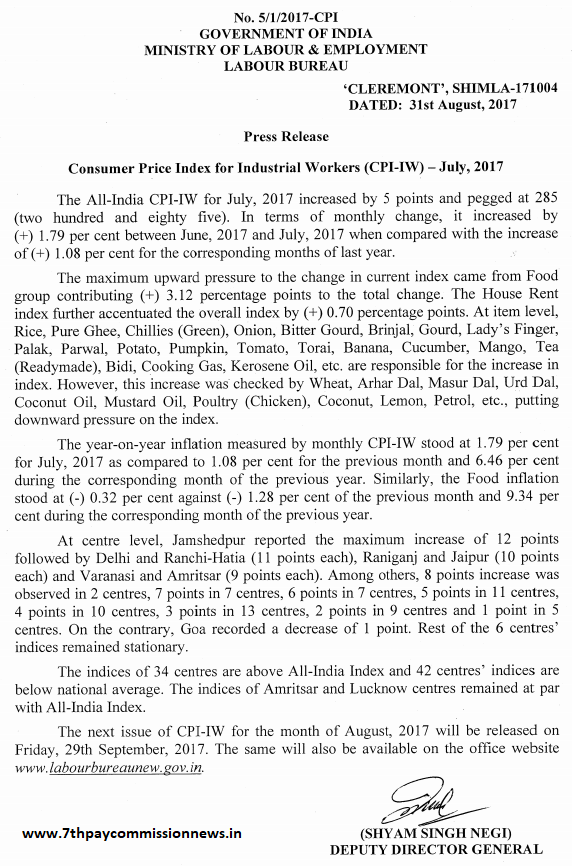
Consumer Price Index for Industrial Workers (CPI-IW) – July 2017
The All India CPI-IW for July, 2017 increased by 5 points and pegged at 285.
The Index increased by 1.79% between June, 2017 and July, 2017 when compared with the increase of 1.08% for the corresponding months of last year.
Read More ->>
Our Postman Shri. Muthukalvan St. Thomas Mount Head Post Office has selected as Deputy Collector
Our Postman Shri. Muthukalvan St. Thomas Mount Head Post Office has selected as Deputy Collector


Read More ->>
Deadline for linking Aadhaar to PAN extended to December 31, 2017
Deadline for linking Aadhaar to PAN extended to December 31, 2017

NEW DELHI: The government on Thursday extended by four months the deadline for linking PAN with biometric identifier Aadhaar till December 31, a source said.
The deadline for linking PAN with Aadhaar for taxpayers was to end on August 31.
This comes at a time when the government has granted a similar extension for furnishing of Aadhaar for availing the benefits of various social welfare schemes.
The revenue department will notify December 31 as the due date for linkage.
Also, the Supreme Court is hearing petitions challenging the government's decision on Aadhaar and has posted the matter for next hearing in November.
And so, the extension was in line, the source said.
Section 139 AA (2) of the Income Tax Act says that every person having PAN as on July 1, 2017, and is eligible to obtain Aadhaar, must intimate his Aadhaar number to the tax authorities.
However, those categorised as non-resident Indians as per the Income Tax laws, people who are not citizens of India, those above 80 years of age and residents of the states of Assam, Meghalaya and Jammu and Kashmir had been exempt from the requirement.
The source further said that people who do not have Aadhaar can file their Income Tax returns, but their returns will not be processed till they submit their Aadhaar number.
The tax department had on July 31 stated that "unless a finding is made that Aadhaar is constitutionally not valid, tax return filers will need to link their PAN with Aadhaar by August 31, 2017."
Incidentally, December 31 is also the deadline for people to link their bank accounts with Aadhaar.
Tax filers, however, were allowed to file their annual income returns by August 5 without linking their Aadhaar with PAN.
They were to just quote Aadhaar or the acknowledgement number for having applied for the ID.
It had further stated that "income-tax returns filed will not be processed should tax filers fail to link Aadhaar and PAN on or before August 31, 2017. "
The deadline for linking PAN with Aadhaar previously was July 31 but was extended to August 31
Read More ->>
Aadhaar-PAN Linking Last Day Today; Here’s What Will Happen if You Don’t Link
Aadhaar-PAN Linking Last Day Today; Here’s What Will Happen if You Don’t Link
Last date for linking your Aadhaar number with PAN is today; here's consequences you may have to face if the two documents are not linked.
New Delhi, August 31: If you haven’t linked your Aadhaar number to Permanent Account Number (PAN), today is the last day. The linking of Aadhaar with PAN has been made mandatory by the government for filing income tax returns. However, the tax payers will have to link their PAN with Aadhaar today which is the stipulated deadline. There were reports that Income Tax department is unlikely to extend the deadline and the failure to link the two would result in non-processing of I-T Returns (ITR). The amended income tax rules have made quoting the 12-digit identification number or Aadhaar enrolment ID compulsory while applying for PAN. Aadhaar number is issued by the Unique Identification Authority of India (UIDAI) to a resident of India while PAN is a 10-digit alphanumeric number allotted by the I-T department to a person, firm or entity.
In the last week, UIDAI CEO Ajay Bhushan Pandey had said that the Supreme Court’s verdict on privacy has no bearing on the requirement quoting Aadhaar for availing government subsidies and welfare schemes. In July, the Income Tax department extended the last date for filing of income tax returns (ITRs) for the financial year 2016-17 from July 31, 2017 to August 5. It warned taxpayers that their IT returns will not be processed until the linking of both the identification proofs- the Aadhaar with PAN is done. The Supreme Court verdict holding privacy as a fundamental right has not stopped quoting of Aadhaar for various schemes as well as the filing of income tax returns.
The Section 139 AA (2) of the Income Tax Act says that every person having PAN as on July 1, 2017 and is eligible to obtain Aadhaar, must intimate his Aadhaar number to the tax authorities. Due to additional compliance requirements, this year, government has given relaxation to link PAN and Aadhaar till August 31, 2017.
Here’s how you can check if your Aadhaar is linked with PAN
- Log on into your account on the income tax department’s e-filing website incometaxindiaefiling.gov.in
- Go to ‘Profile Settings’ Tab and click on it to see if your Aadhaar number is linked there.
- In case not, here is how to link your Aadhaar with PAN card
Here’s what will happen if you don’t link it today:
- It has to be noted that linking of Aadhaar and PAN has been made mandatory by the government to file Income Tax returns. In case of failure to link the two, an individual’s ITR will not be processed as the return filed would become null and void.
- Not linking the two documents will be treated as you have not filed your returns for the financial year 2016-17.
- An individual will not be able to claim or carry forward losses such as capital loss, business losses, etc. The refunds shall not be granted in case ITR is not processed.
- If the Aadhaar and PAN are not linked, the income tax department may send you a notice to file your ITR under section 142(1). The assessing officer may levy a penalty of Rs 5,000 for not filing ITR on time.
- An individual may have to pay heavy interest as section 234 A, B, C will be applicable as the case may be, i.e., if the tax is payable.
The Central Board of Direct Taxes (CBDT) which is the policy-making body of the department has extended the last date for citizens to link their Aadhaar number with their Permanent Account Number to August 31. It said that for the purpose of e-filing of returns (by August 5), it would be sufficient to quote Aadhaar, on the e-filing website of the department. The main aim to link Aadhaar number to PAN is to curb black money and streamline the entire tax filing process. Currently, the Unique Identification Authority of India has allotted these biometric-based documents to 115 crore Indians. As per reports by PTI, the government had told the Supreme Court that it is extending deadline for quoting Aadhaar in welfare schemes till 31 December which was earlier 30 September. As per reoports, a bench of Chief Justice Dipak Misra, Justice Amitava Roy and Justice A.M. Khanwilkar said the challenge to the constitutional validity of the Aadhaar scheme would be heard in the first week of November. Attorney General K.K. Venugopal told the court that the existing deadline of September 30 would be extended by three months.
Read More ->>
Atal Pension Yojana (APY) surges ahead with 62 lakh enrolment
Atal Pension Yojana (APY) surges ahead with 62 lakh enrolment
The Pension Fund Regulatory and Development Authority (PFRDA) through its ‘One Nation One Pension’ Mobilization Campaign has sourced approximately 3.07 lakh APY accounts which led to a total of 62 lakh enrolments under the Atal Pension Yojana (APY) as on date. This campaign was organized all over the country by PFRDA from 2nd August to 19th August 2017 in association with the APY Service Provider Banks. Increasing enrolment is attributed to financialization of assets and driving the people to pension products which has Govt of India implicit guarantee to give an assured pension to the subscriber, spouse and return of corpus to the nominee.
Under the campaign some of the largest banks in the country namely, State Bank of India helped source 51,000 APY accounts and other prominent banks like Canara Bank which has sourced 32,306 APY accounts, Andhra Bank at 29,057 APY accounts, in other private banks category, Karnataka Bank at 2641 APY accounts, in RRB’s category, Allahabad UP Gramin Bank at 28,609 accounts followed by Madhya Bihar Gramin Bank at 5,056 APY accounts , Baroda Uttar Pradesh Gramin Bank at 3,013 APY accounts, Kashi Gomti Samyut Gramin Bank at 2,847 APY accounts & Punjab Gramin Bank at 2,194 APY accounts.
At a time when the interest rate on various financial instruments including Savings Bank is declining, Atal Pension Yojana as a pension scheme offers a guaranteed rate of 8% assured return for the subscribers and also the opportunity of higher earnings in case the rate of return is higher than 8% at the time of maturity, after staying invested in the scheme for 20-42 years. Department of Financial Services in association with Pension Fund Regulatory and Development Authority (PFRDA) has been organizing various APY campaigns to give thrust through which the population not covered by any pension scheme is approached by APY Service Provider banks and Department of Posts to inform about the salient features and benefits of the APY scheme and are encouraged to get enrolled in the scheme.
The objective of PFRDA is to cover the maximum possible population uncovered by any pension scheme under the APY scheme so that India as a nation can move from a pension less to a pensioned society and the citizens can live a life of dignity in their vulnerable years.
Source : PIB
Read More ->>
Transfer/posting in the Senior Administrative Grade (SAG) of Indian Postal Service, Group 'A'
Transfer/posting in the Senior Administrative Grade (SAG) of Indian Postal Service, Group 'A'

Read More ->>
OBC creamy layer concept extended to PSUs, financial institutions
OBC creamy layer concept extended to PSUs, financial institutions

Finance minister Arun Jaitley briefs the media after a cabinet meeting in New Delhi on Wednesday.(Vipin Kumar/HT Photo)
The Union Cabinet chaired by Prime Minister Shri Narendra Modi has given its approval to the norms for establishing equivalence of posts in Government and posts in PSUs, PSBs etc. for claiming benefit of OBC reservations. This addresses an issue pending for nearly 24 years. This will ensure that the children of those serving in lower categories in PSUs and other institutions can get the benefit of OBC reservations, on par with children of people serving in lower categories in Government. This will also prevent children of those in senior positions in such institutions, who, owing to absence of equivalence of posts, may have been treated as non Creamy Layer by virtue of wrong interpretation of income standards from cornering government posts reserved for OBCs and denying the genuine non creamy layer candidates a level playing field.
The Union Cabinet also approved the increase in the present income criterion of Rs. 6 lakh per annum for applying the Creamy Layer restriction throughout the country, for excluding Socially Advanced Persons/Sections (Creamy Layer) from the purview of reservation of Other Backward Classes (OBCs). The new income criterion will be Rs. 8 lakh per annum. The increase in the income limit to exclude the Creamy Layer is in keeping with the increase in the Consumer Price Index and will enable more persons to take advantage of reservation benefits extended to OBCs in government services and admission to central educational institutions.
These measures are a part of the Government's efforts to ensure greater social justice and inclusion for members of the Other Backward Classes. The Government has already introduced in Parliament, a bill to provide Constitutional status to the National Commission for Backward Classes. It has also decided to set up a Commission, under section 340 of the Constitution, to sub categorize the OBCs, so that the more backward among the OBC communities can also access the benefits of reservation for educational institutions and government jobs. All these decisions, taken together, are expected to ensure greater representation of OBCs in educational institutions and jobs, while also ensuring that the more under-privileged within the category are not denied their chance of social mobility.
Background:
In its judgment dated 16.11.1992 in WP(C) 930/1990 (IndraSawhney case) the Supreme Court had directed the Government to specify the basis, for exclusion of socially and economically advanced persons from Other Backward Classes by applying the relevant and requisite socio-economic criteria.
An Expert Committee was constituted in February 1993 which submitted its report on 10.03.1993 specifying the criteria for identification of socially advanced persons among OBCs i.e. the Creamy Layer. The report was accepted by the then Ministry of Welfare and forwarded to DoPT which issued an OM dated 08.09.1993 on exclusion from the Creamy Layer.
The OM of 08.09.1993 specifies six categories for identifying Creamy Layer (a) Constitutional/Statutory post (b) Group ‘A’ and Group ‘B’ Officers of Central and State Governments, employees of PSUs and Statutory bodies, universities, (c) Colonel and above in armed forces and equivalent in paramilitary forces (d) professionals like Doctors, Lawyers, Management Consultants, Engineers etc. (e) Property owners with agricultural holdings or vacant land and/or buildings and (f) income/wealth tax asessee.
The OM further stipulates that the said parameters would apply mutatis mutandis to officers holding equivalent or comparable posts in PSUs, Banks, Insurance Organizations, Universities, etc. and Government was required to determine equivalence of positions in these organizations with those in Government.
Pending the equivalence to the established in these institutions Income criteria would apply for the officers in these Institutions.
However, this exercise of determining the equivalence of posts in Government and posts in PSUs, PSBs etc. had not been initiated. The determination of equivalence of posts has been thus pending for almost 24 years.
The matter of formulating equivalence has since been examined in detail. In PSUs, all Executive level posts i.e. Board level executives and managerial level posts would be treated as equivalent to group 'A' posts in Government and will be considered Creamy Layer. Junior Management Grade Scale–1 and above of Public Sector Banks, Financial Institutions and Public Sector Insurance Corporations will be treated as equivalent to Group 'A' in the Government of India and considered as Creamy Layer. For Clerks and Peons in PSBs, FIs and PSICs, the Income Test as revised from time to time will be applicable. These are the broad guidelines and each individual Bank, PSU, Insurance Company would place the matter before their respective board to identify individual posts.
******
AKT/VBA/SH
(Release ID :170348)
Source : http://pib.nic.in/newsite/erelease.aspx?relid=0
Read More ->>

 →


