


Promotion Posting of HAG officers - Member ( Banking and DBT ) Postal Services

Read More ->>


Promotion Posting of HAG officers - Member ( Banking and DBT ) Postal Services
AYUSH
AYURVEDIC WHOLE SYSTEM EFFECTIVE IN MANAGING RHEUMATOID ARTHRITIS: STUDY
Posted On: 29 AUG 2024 4:22PM by PIB Delhi
A new scientific study has revealed the significant effectiveness of the Ayurvedic Whole System (AWS) in the management of Rheumatoid Arthritis (RA), a chronic autoimmune disorder affecting millions worldwide. This pioneering research demonstrates that AWS not only alleviates the symptoms of RA but also induces a metabolic shift towards normalisation in patients, offering a promising complementary approach to conventional treatments.
The study was conducted by a group of senior researchers from reputed research institutions, including Arthritis Treatment and Advanced Research Center (A-ATARC), Department of Kaya Chikitsa, State Ayurvedic College and Hospital, Lucknow University; Centre of Biomedical Research (CBMR), SGPGIMS Campus, Lucknow; Academy of Scientific and Innovative Research (AcSIR), Ghaziabad.
“This study is significant from the perspective of possible pathology reversal in case of RA being treated with whole system Ayurveda approach. This endorses ayurvedic concepts of ‘Samprapti Vighatan’ where a pathogenesis – disease complex is dismantled and ‘Doshas’ are brought back to normality.”, mentioned the first author Dr. Sanjeev Rastogi.
Published in the PubMed-indexed research journal, Journal of Ayurveda and Integrated Medicine (JAIM), the study highlighted substantial improvements in key clinical parameters among RA patients who underwent AWS intervention. There was a notable reduction in Disease Activity Score-28 Erythrocyte Sedimentation Rate (DAS-28 ESR), as well as decreases in both the total number of swollen and tender joints. Additionally, the Ama Activity Measure (AAM) Score, which assesses the presence of toxins in the body, also showed a significant reduction post-intervention.
The research further explored the metabolic profiles of RA patients, comparing them to healthy controls. At the study's outset, RA patients exhibited elevated levels of certain metabolites, including succinate, lysine, mannose, creatine, and 3-Hydroxybutyrate (3-HB), alongside decreased alanine levels. However, following AWS treatment, these metabolic markers began to shift towards the levels observed in healthy individuals, indicating a return to a more balanced metabolic state.
As per the researchers, this study is the first of its kind to clearly demonstrate the clinical efficacy of AWS in managing RA. The intervention not only reduced symptoms but also promoted a metabolic environment conducive to homeostasis, potentially leading to long-term benefits for RA patients.
While these findings are promising, the study's authors emphasise the need for further research to confirm these preliminary results and to better understand the mechanisms through which AWS exerts its therapeutic effects.
This breakthrough underscores the potential of integrating traditional Ayurvedic practices with modern medical approaches to improve patient outcomes in chronic conditions like Rheumatoid Arthritis.
Study Link : https://www.ncbi.nlm.nih.gov/pmc/articles/PMC11264181/
SK (Release ID: 2049763)
Deputation of Group ‘B’ Officers of the Central Government to State Governments/UT Admn. – Modification in guidelines: DoP&T O.M. dated 30.08.2024
No.6/8/2023-Pers.Policy (Deputation/Re-employment) Pt.XV
Government of India
Ministry of Personnel, Public Grievances and Pensions
Department of Personnel & Training
North Block, New Delhi.
Dated : 30th August, 2024.
OFFICE MEMORANDUM
Subject: Deputation of Group ‘B’ Officers of the Central Government to State Governments/UT Admn. – Modification in guidelines – regarding.
The undersigned is directed to invite attention to the consolidated guidelines/instructions dated 28.03.2024 uploaded on the website of the Deptt. of Personnel & Training (DoPT) regulating the terms and conditions governing deputation/foreign service of employees to/from. Central government including instructions/guidelines to be followed in connection with transfer on deputation /foreign service of Central Government employees to ex-cadre posts under Central Government /State government /Union Territories administration/Public Sector Undertakings/Autonomous Bodies/ Statutory Bodies/Universities /Local Bodies etc. and vice versa.
2. Attention is also drawn to para 1.3 of this Department’s OM No.AB-14017/2/2007-Estt (RR) dated 29.02.2008 indicating the provisions regulating tenure and procedure of appointment on deputation /foreign service of members of the Organized Group ‘A’ and Group ‘B’ Services of the Central Government.
3. In consonance with the provisions governing deputation of Group ‘A’ officers of the Central Government to ex-cadre posts under State Government/ UT Admn., issued vide this Department’s O.M. No.6/8/2023-Pers. Policy (Deputation/Re-employment) Pt. XV dated 15.03.2024 and suitably incorporated in the consolidated guidelines/instructions dated 28.03.2024 referred above, deputation of Group ‘B’ employees of the Central Government to the ex-cadre posts under a State Government /UT Administration including PSUs/ Autonomous bodies/Statutory Bodies/ Universities/Local Bodies under the State Governments/UT. Administration would be regulated as per the following procedure, to be strictly adhered to by the Cadre Controlling Authorities (CCAs) of lending organizations:
(i) All such cases shall be submitted for consideration and approval of Hon’ble Minister of State (PP).
(ii) Such deputation will be available to the officers only after completion of nine years of service in parent Cadre. :
(iii) 1st July of the batch year is to be considered as the starting date of calculating length of service for the purpose of counting nine years of eligibility of the employees seeking deputation. In case of promotee employees, nine years of eligibility service for seeking such deputation shall be counted from the 15 July of the year of allotment/induction into Group ‘B’ service/post.
(iv) A request for such deputation will be entertained only if it is forwarded by the Cadre Controlling Authority along with NOC/consent of the borrowing State Government/UT Admn.
(v) All such cases of deputation to State Governments/UT Admin. will be initially restricted to three years, extendable by two more years after review. Where the initial period of-deputation is for less than three years, continuation of the officer on deputation basis beyond the initial period, shall be treated as a case of extension of that deputation, requiring prior approval of the Hon’ble MOS (PP).
(vi) The: total allowable period of such deputation to any State Government/UT Administration including PSUs/ Autonomous bodies/Statutory Bodies/ Universities/Local Bodies in the States/UT Administration in the entire career of the officer shall be restricted to five years. No extension of deputation beyond five years shall be allowed.
(vii) Employees who are already on deputation may be allowed to complete their full term.
(viii) A request for extension of deputation after the initial period of deputation (subject to restriction of the overall tenure of deputation of five years) will be entertained only if it is forwarded by the concerned Cadre Controlling Authority along with NOC of the borrowing State Government, with cogent reasons and at least three months prior to the expiry of the period of deputation. In case no specific approval of the Central Government for extension is received within the period for which deputation was originally valid, the employee shall have to be relieved positively and immediately on completion of the original tenure.
(ix) In cases where an employee has completed the approved period of deputation, it would be made clear to the employee concerned and to the Cadre Controlling Authority concerned that adverse notice will be taken at the time of empanelment and promotion of the employee if he/she continued on such deputation beyond the approved period of deputation.
(x) The deputation is valid only for the period for which it is allowed by the Central Government and any extension is neither automatic nor should be presumed merely on the ground that the Cadre Controlling Authority or the employee or both made a request for extension. As such, the employee concerned shall be entitled to draw salary etc. in the borrowing State Government/UT Admn. to which he/she has been deputed only for the period for which he/she has been allowed deputation by the Government of India. The employee shall not be entitled to draw salary etc. after expiry of the period of deputation. An employee on such deputation shall relinquish charge and get himself/herself relieved on the last day of his/her deputation, if no orders extending his/her deputation by the concerned Cadre Controlling Authority are received in the borrowing State Government/UT Admn.
(xi) An employee who does not handover charge at the end of the approved period of deputation will be immediately liable to disciplinary action and break-in-service for the period beyond the approved date. All orders of deputation will carry endorsement to this effect. Further, an endorsement will also be made to the Pay & Accounts Office concerned to stop payment of salary to the employee beyond the approved period of deputation.
(xii) Copies of all deputation orders must be marked to/served on the employee concerned along with State Government/ UT/ borrowing Organisation and others concerned.
(xiii) In the event the employee overstays for any reason whatsoever, he/she is liable for disciplinary action and other adverse Civil/Service consequences which would include the period of overstay not being counted towards service for the purpose of pension and any increment due during the period of overstay being deferred with cumulative effect, till that date on which he/she re-joins in the parent Cadre.
(xiv) The State Governments/UT Admn./ borrowing Organisations are advised to relieve the employee promptly on the last date of completion of the deputation tenure without fail unless the competent authority in the Central Government extends the period of deputation in writing prior to its date of expiry.
(xv) Grant of leave to the employee on completion of tenure of deputation: On reversion from such deputation, the employee concerned might be allowed leave not exceeding two months by the concerned borrowing State Government/UT Admn. where the employee was on deputation. The employee concerned should apply for further leave to his/her parent Cadre. Further, such leave is debitable from the leave account of the employee concerned.
(xvi) Cooling off period: ‘Cooling off’ requirement between two spells of deputation shall be governed by the relevant provisions contained in ‘Consolidated guidelines on deputation/foreign service for Central Government employees issued vide DOPT’s O.M. No.DOPT-1716267915093 dated 28.03.2024.
(xvii) Relaxation of policy guidelines:
| 1. | Additional/ Joint Secretary (Pers. Policy), Department of Personnel & Training | Chairperson |
| 2. | Additional/ Joint Secretary in-Charge of CS Division, Department of Personnel & Training | Member |
| 3. | Additional Secretary/ Joint Secretary (Admn) or an officer equivalent rank in the Administrative Ministry/ Department concerned. | Co-opted Member |
| 4. | Director/Deputy Secretary (Pers. Policy (Pay), Department of Personnel & Training | Convenor |
(xviii) In terms of clause (v) of this O.M., the designated Committee shall consider all cases 2 seeking extension of deputation beyond 3 years. Only those cases recommended by the Committee for extension of deputation beyond 3 years, would be placed before the Competent Authority for consideration. As a one time measure, the aforesaid Committee shall also review present cases of deputation to State -Governments/UT Administration PSUs/ Autonomous bodies/Statutory Bodies/ Universities/Local Bodies under the States/UT Administration where the remaining tenure of the officer is six months or more. After review, the Committee shall give its recommendation for continuation of the employee concerned till the end of the term of deputation. Such cases shall! thereafter also be submitted for consideration and approval of the Hon’ble MOS (PP).
(xix) The Cadre Controlling Authority shall consider all cases of deputation of Group ‘B’ employees of Central Government to State Governments/UT including PSUs/Autonomous bodies/Statutory Bodies/Universities/Local Bodies under the States/UT Administration keeping in view the aforementioned guidelines and submit the cases involving relaxation of any of these provisions, alongwith the approval of the Minister in-Charge, to the DoPT for consideration of the relaxation proposed.
4. Provisions contained in para 1.3 of this Department’s OM No.AB-14017/2/2007-Estt (RR) dated 29.02.2008, to the extent they govern the deputation of Group ‘B’ officers of the Central Government to ex-cadre posts under State Governments/Union Territories including PSUs/ Autonomous bodies/Statutory Bodies/ Universities/Local Bodies in the States/UT Administration stand modified accordingly. All other instructions /guidelines consolidated vide DoPT’s OMs dated 29.02.2008 and 28.03.2024 shall remain unaltered.
5. All the Cadre Controlling Authorities may submit the proposal with the approval of Minister-in-Charge, through e-office, for deputation/extension of deputation tenure in respect of Group ‘B’ Officers to ex-cadre posts under State Government/ UT Admn. as per the Check List, (proforma enclosed as Annexure) duly signed, alongwith all requisite documents to this Department for consideration/approval of the Competent Authority.
6. These guidelines shall be applicable with immediate effect.
7. Hindi version will follow.
(Mahesh Kumar)
Under Secretary to the Govt. of India
Tel: No.011-23040489
Promotional Posting and Transfer Posting Order of IPOs Group A Officers in Department of Posts


Is the Unified Pension Scheme Better Than NPS? What You Need to Know Before Switching to UPS in 2025
Switching from the National Pension Scheme (NPS) to the Unified Pension Scheme (UPS) requires careful consideration, particularly since the full details of the UPS are not yet finalized. Here are some factors to consider based on the available information:
Thinking about switching from the National Pension Scheme to the Unified Pension Scheme? With the Unified Pension Scheme launching on April 1, 2025, many government NPS subscribers are wondering if they should make the move. Check out this Unified Pension Scheme Salient Features and decide!
If you’re a government NPS subscriber, you can switch to the UPS, but you’ll need to transfer most of your NPS funds to the new scheme. For those in the UPS, the monthly contribution will be 10% of your basic pay plus DA, while the government will chip in 18.5%, which can vary based on actuarial assessments.
According to the CNBCTV18.Com Report, here’s what it says:
“The announcement has sparked a debate among employees currently enrolled in the National Pension System (NPS) about whether they should transition to the new UPS.”
According to Krishan Mishra, CEO of FPSB India, one of the most appealing aspects of the UPS is its hybrid model.
“UPS will offer a combination of the stability of Old Pension System’s (OPS’s) fixed benefits with the flexibility and self-contribution features of NPS,” he explained.
Mishra pointed out that unlike OPS, which placed a significant financial burden on the government, the UPS is designed to cap this burden while ensuring that employees still receive a secure post-retirement income.
“The government is likely to find this approach more fiscally sustainable in the long term,” he added.
For individuals, the UPS offers increased pension security by blending the assured benefits of OPS with the market-based returns of NPS.
“Compared to NPS, UPS may offer more predictable benefits and security for retirees,” said Mishra.
He also pointed out that the government’s increased contribution from 14% to 18.5% is a welcome step that could enhance the overall pension outcomes.
However, the transition to UPS is not without challenges.
Mishra emphasized the potential market risks and the complexity of managing a hybrid pension system.
“While UPS offers more security than NPS, it might not match the full guaranteed benefits of OPS,” he cautioned.
A balanced solution?
Experts believe that the UPS has the potential to combine the best elements of both OPS and NPS.
However, they also acknowledged that political and logistical challenges could complicate the implementation of the scheme.
Additionally, the decision to switch from NPS to UPS depends on individual circumstances.
Some suggest that younger employees should stay with NPS for potentially higher returns from equity market investments.
Others advocate for the UPS due to its guaranteed pension benefits, which could appeal more to employees closer to retirement.
The comparison between NPS and UPS raises the question of which option is better. UPS offers a guaranteed pension amount, whereas the pension amount from NPS is contingent upon the performance of investments in market-linked securities. While UPS ensures a fixed pension, NPS has the potential to yield a higher pension amount due to the possibility of greater returns from market investments. Employees who prefer a risk-free, guaranteed pension may find UPS to be more advantageous, whereas those willing to engage in market-based investments for potentially higher returns may favor NPS.
So you need to consider the above aspects and calculate the benefits in both schemes before taking a decision on NPS or UPS
Implementation of Unified Pension Scheme effect from 01.04.2025
BRIEF
Ministry of Finance, Department of Expenditure
Dated: 24.08.2024
Unified Pension Scheme (UPS)
Cabinet has approved introduction of Unified Pension Scheme (UPS) to improve the National Pension System (NPS) for Central Government employees. Government employees have been representing that they need certainty in their pension, in particular assurances regarding pension, family pension, minimum pension and inflation indexation. While Government is keenly aware of these concerns, Government also has a responsibility to protect the interest of the common citizen so that pension does not lead to a huge burden of higher taxes for them in future.
Keeping this in view, Government had appointed a committee, headed by the Finance Secretary to review the existing NPS and to make recommendations in the matter. The Committee consulted the State Governments as well as the representatives of the employees and considered suggestions from associations, experts, etc. The Committee also looked at international experience and consulted the Reserve Bank of India. The Committee has now submitted its report. The UPS is based on the recommendations of the Committee.
The recommendations of the Committee were discussed with representatives of the employees through the Staff Side of the National Council of Joint Consultative Machinery (JCM). The employee representatives gave valuable suggestions to the Committee in reaching a broad consensus.
The Broad contours of UPS include the following:
Employees who have adequate service will get an assured pension of at least 50% of the last 12 months’ average salary as pension.
Minimum pension of Rs 10,000 per month will be given to those with at least 10 years’ service.
Family pension to spouse will be given @60% of the pension.
Dearness relief will be given on the assured pension, minimum pension and family pension.
In addition, a lumpsum will be provided at the time of retirement.
There will be no increase in the contribution from employees but Central Government will increase its contribution. Those who have already retired under NPS will also be eligible for this benefit. Arrears will be paid to such past retirees after adjusting the withdrawals already made by them.
The scheme details and eligibilities are given below.
The employee contribution shall remain un-altered at 10% of (Basic pay + DA). The Government contribution will increase from the present 14% to 18.5%. The pension corpus will be divided into two funds:
The employee can exercise an investment choice for the individual pension corpus alone. The employee can withdraw upto 60% of the individual pension corpus with proportionate reduction in assured pension.
Assured pension will be based on the ‘default mode’ of investment pattern notified by PFRDA and considering full annuitization of individual pension corpus. In case the benchmark annuity is lower than the assured annuity, the shortfall will be made good. In case the individual employee corpus generates higher than assured annuity (based on investment choice exercised by the employee), the employee will be entitled to such higher annuity. In case however, the annuity generated is lower than the default mode, the top up provided by Government through UPS will be limited to the benchmark annuity
Full assured pension will be available for a minimum qualifying service of 25 years. For lesser service, starting from at least 10 years, pro rata assured pension will be given.
Employees would have a choice to opt for UPS. An employee could choose to continue with the NPS, if s/he so desires.
The UPS will be given effect from 01.04.2025. The necessary administrative/ legal support framework will be put in place.
The scheme can also be adopted by State Governments. This is expected to benefit over 90 lakh employees (23 lakh Central Government employees, 3 lakh employees of Central Autonomous Bodies and another 56 lakh employees of State Governments and 10 lakh employees of State Autonomous Bodies, if adopted by the State Governments).
While benefiting the employees, it will also safeguard the welfare of the common citizens because the scheme will be fully funded, i.e. Government will fully pay its contribution each year and will not postpone the pension expenditure, thus preventing fiscal hardship to future generations of citizens.
High Court Defends Pension Rights, Overrules GPF Deduction Lapse
Allahabad High Court ruled that an employee cannot be denied pension due to the employer’s fault in not allotting a General Provident Fund (GPF) number. Justice Subhash Vidyarthi emphasized that GPF deductions are not a prerequisite for pension eligibility and that the petitioner was not responsible for the non-deduction of his contributions.
The petitioner, an Assistant teacher appointed in 2004, faced salary payment issues initially resolved by the High Court. However, no GPF deductions were made until 2022, when the petitioner was close to retirement. The petitioner retired on March 31, 2023, but did not receive his pension, leading him to approach the High Court again.
The Court noted that a government order from 1978 provided pension rights to permanent, full-time teachers in state-aided institutions similar to government school teachers, even if no GPF deductions were made. It highlighted that GPF deduction is not a condition for pension eligibility under Rule 6 of the U.P. General Provident Fund, Insurance, and Pension Scheme Rules.
The Court further stated that since the petitioner was not responsible for the absence of GPF deductions, he should not suffer for the employer’s oversight. Consequently, the Court allowed the petition and directed payment of pension arrears to the petitioner.
Enhancing the Unified Pension Scheme with the Restoration of GPF


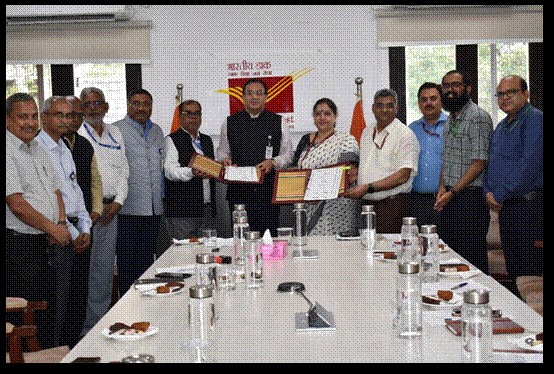
Department of Posts and NRSC, ISRO Forge New Partnership to Revolutionize India’s Addressing System
Transfers and postings of Senior Administrative Grade (SAG) officers of Indian Postal Service, Group ‘A




 →
→

